Category Archives: On this day

1719/265172 Pte Fred Pilgrim from Nottingham

A Pre-War Territorial who enlisted in February 1913. Arrived in France with the 46th Division in February 1915. Transferred to the 1/6th Battalion – probably in January 1917. Disembodied in March 1919.
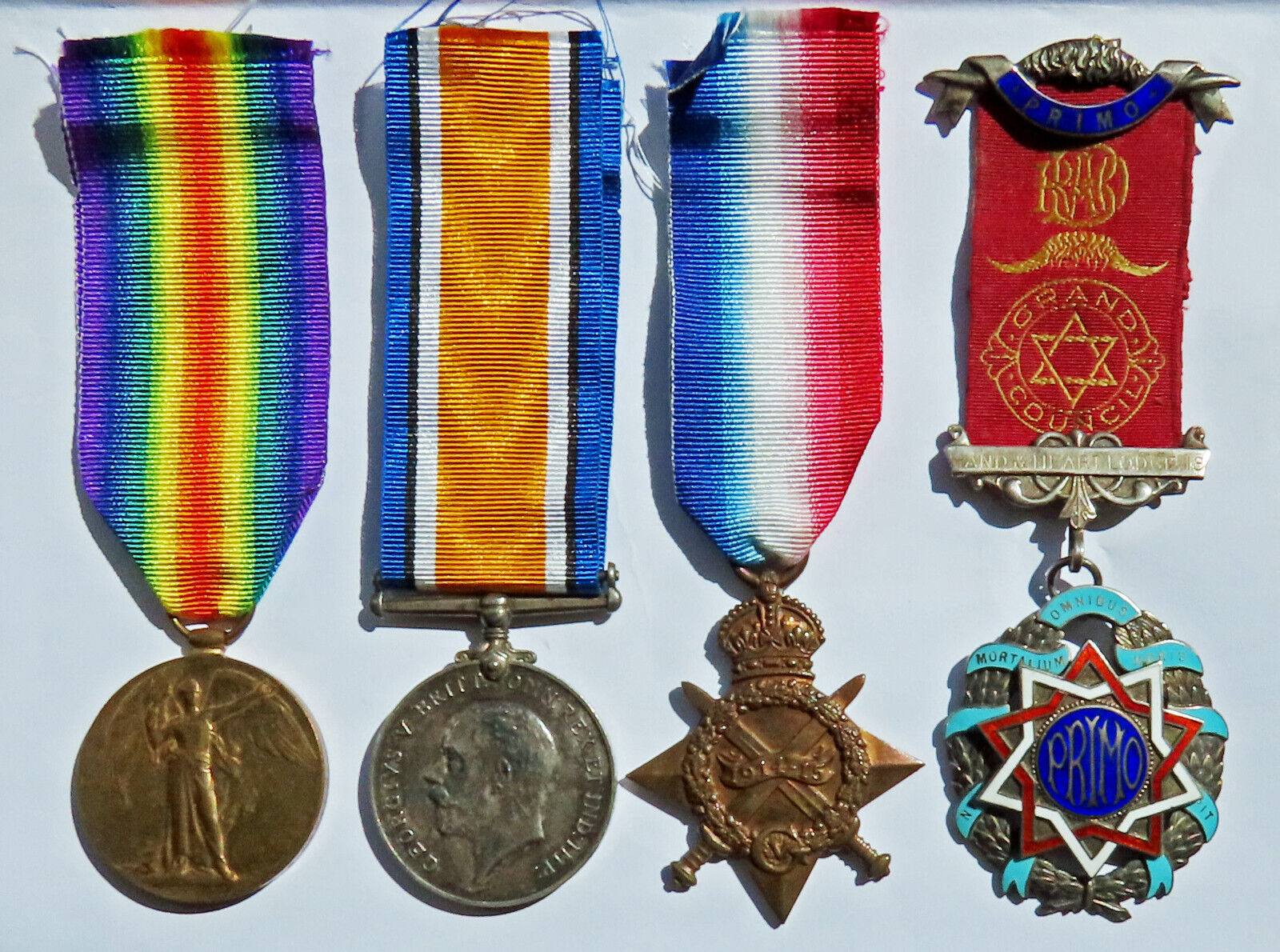
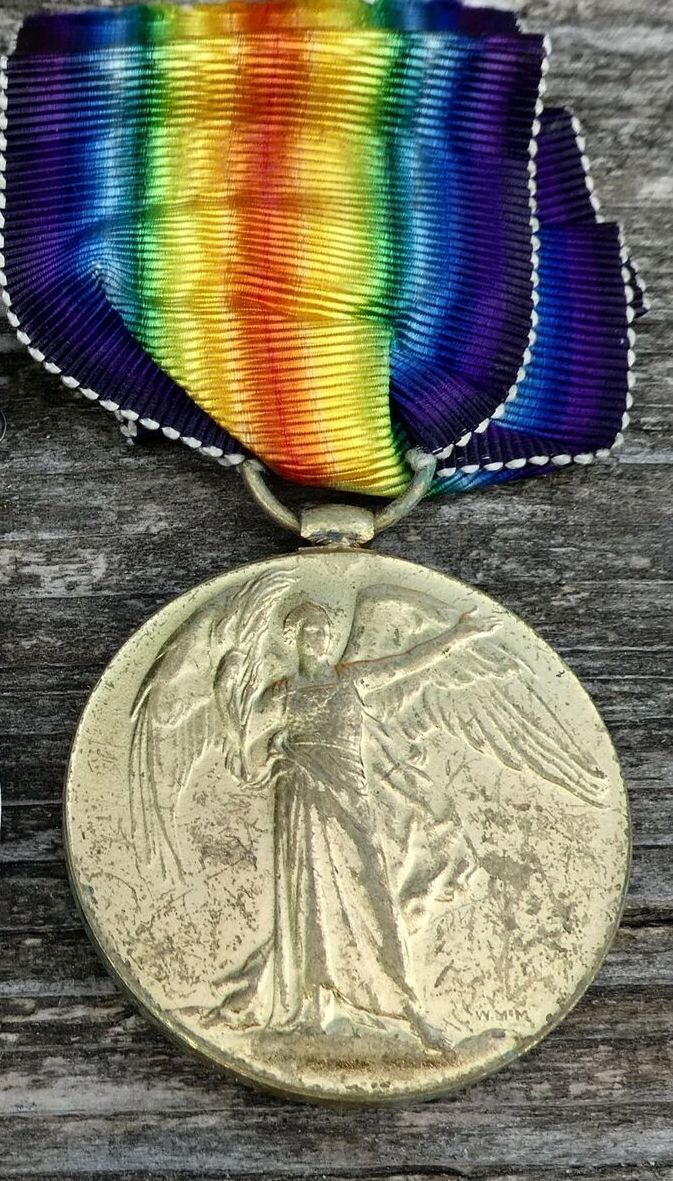
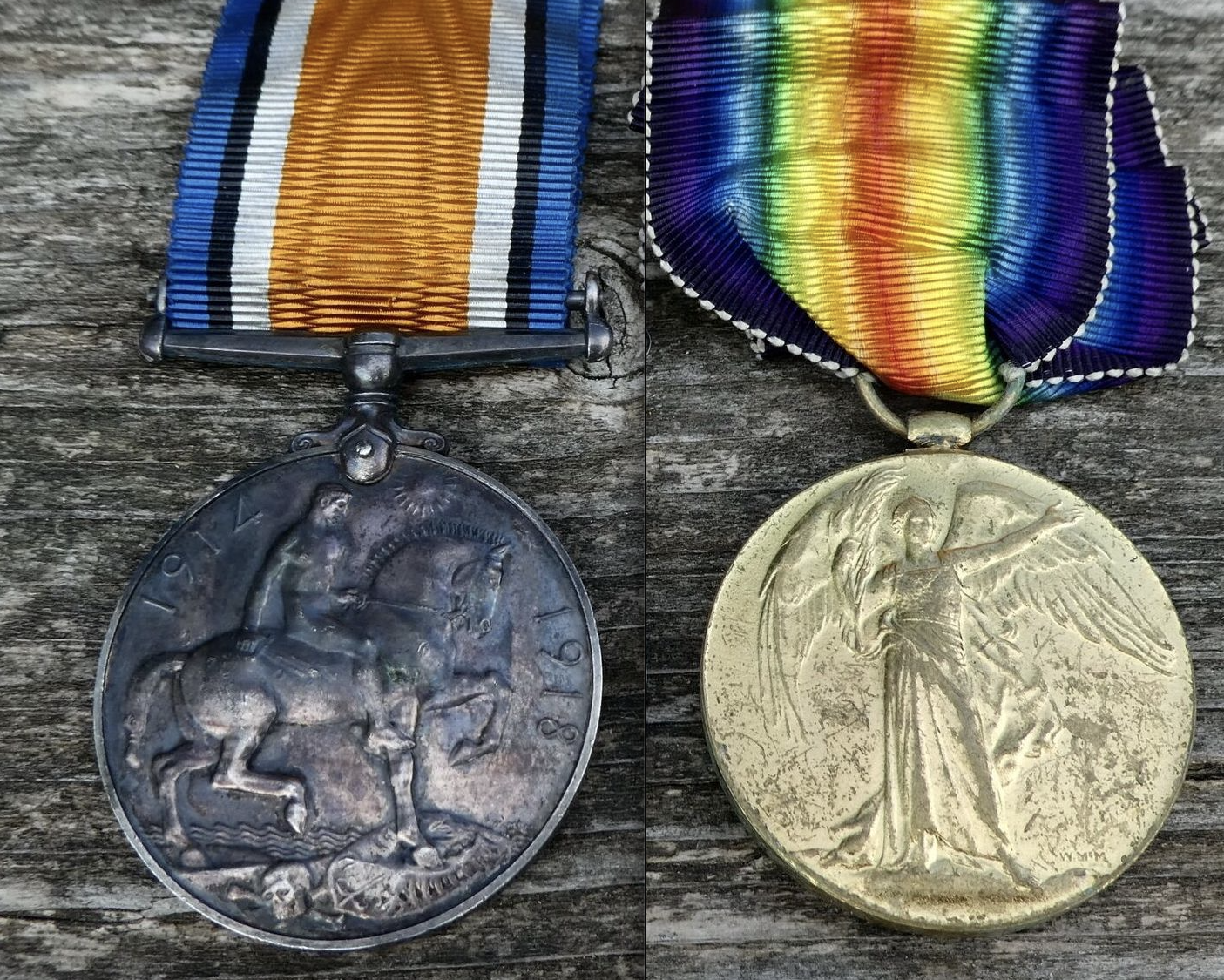
Fred’s WW1 Medal entitlement including his Masonic Medal

Medal Index Card summarising his War experience

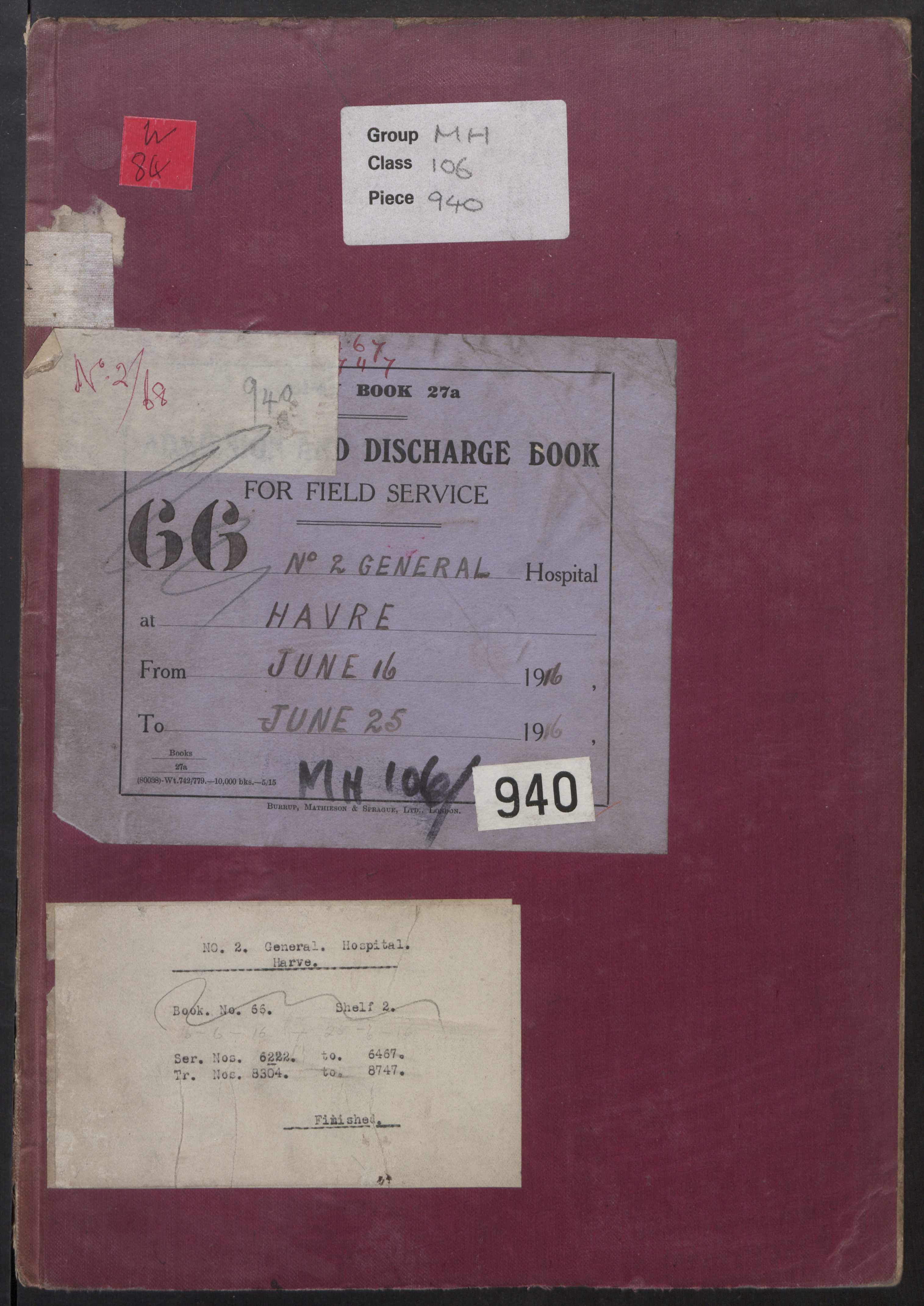
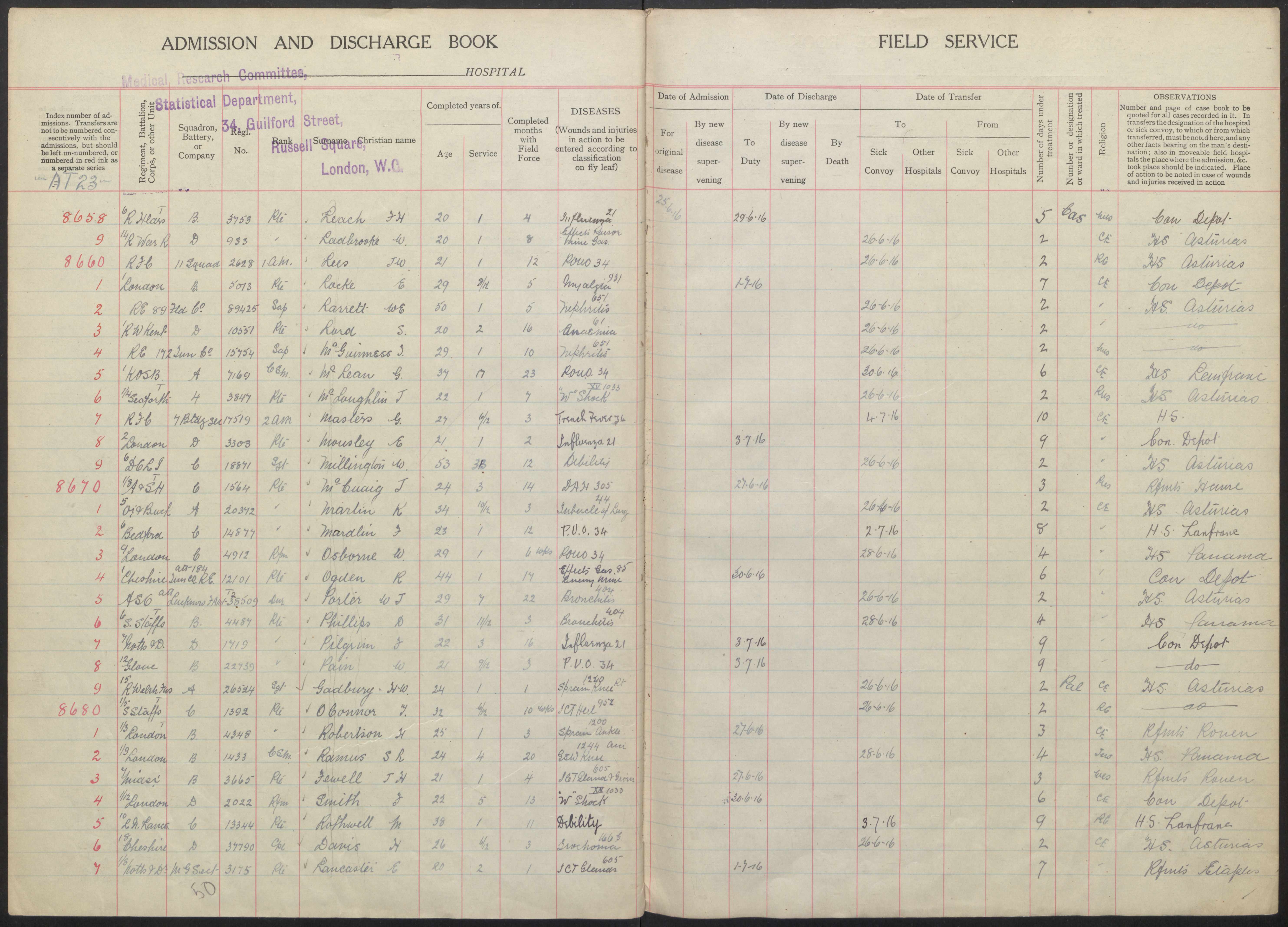
Fred was admitted with influenza to No2 General Hospital at Havre on the 25th June 1916 (?) suggesting that he missed the debacle that was the ‘1st day of the Somme’.
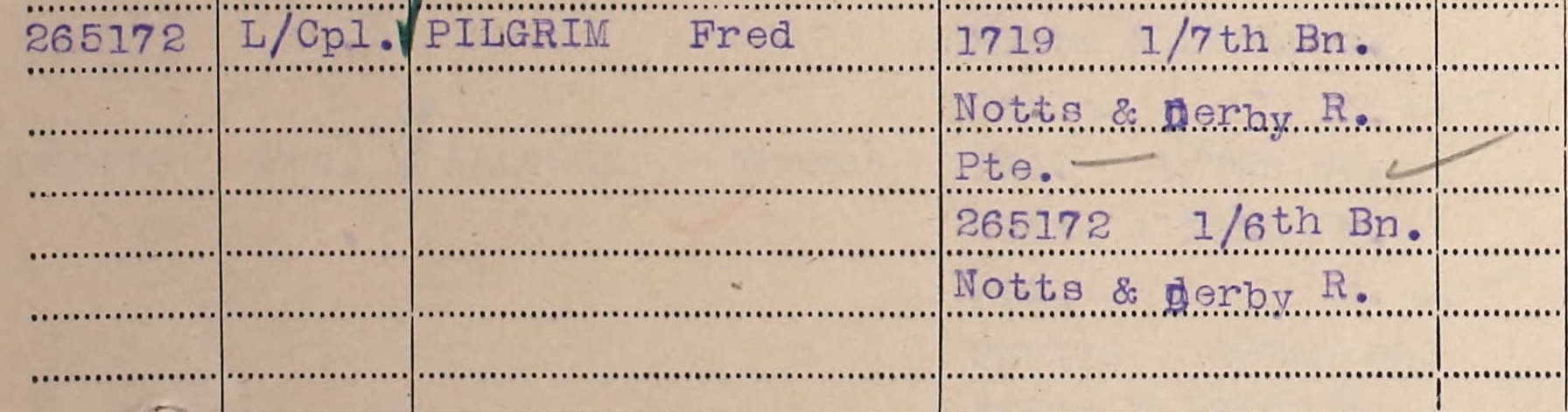
Medal Roll

Fred was still serving with the 1/7th Battalion at the time of the Territorial Force renumbering and was issued with the Regimental number 265172, which was with the block assigned to the 7th Battalion Sherwood Foresters (265001-305000).

It is highly likely that Fred was to the 1/6th Battalion when the 1/7th Battalion was disbanded in January 1917.

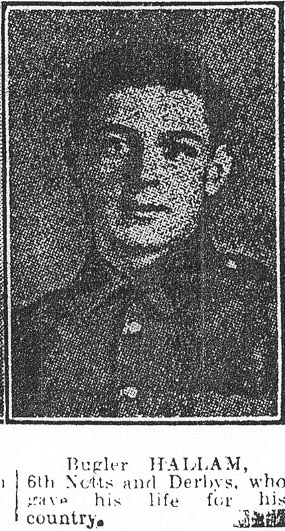
2142 Drummer Frank Hallam from Fairfield in Buxton

Killed in action on 22nd July and buried in Maple Copse

Maple Copse 22.7.1915: CAPTS F. M. DICK, E. B. JOHNSON and LIEUTS J. S. SAMPSON and J. L. PERCIVAL joined from England having joined bivouac day before.

Casualties – wounded Officers nil – O.R. killed 3 wounded 19.

War Diary [WO/95/2694]

“It is artic up here………”

Posted from Scarborough Camp in 1909 by Will who was in “D” Company, the Robin Hood Rifles.

“Duke”; Mascot of the 1/6th Battalion taken in 1909

Mon July 26/09

D Co RHR

Scarboro

“Hope you had a good day to day. I would sooner have been at home. It is artic up here. No catch at all. Will”
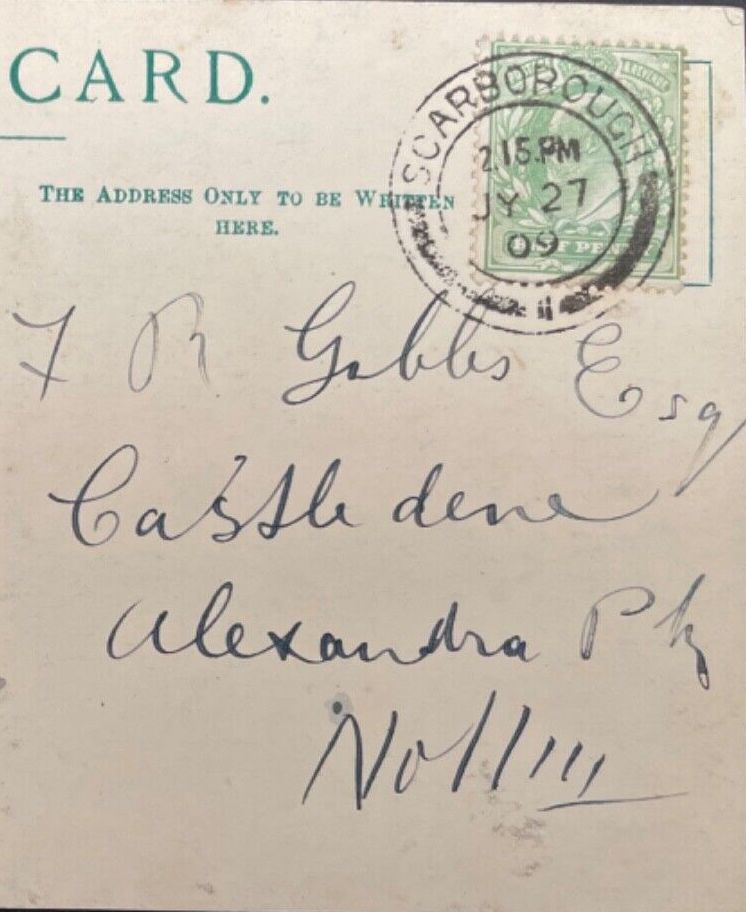
The post card was posted to:-

F R Gibbs Esq, Castledene, Alexandra Park, Nottingham


Frederick Richard Gibbs was a well know Nottingham clock and watch maker – see here. By 1911 the Gibbs Family had moved to ‘Castledene’. He and his wife a son called Frederick William, who was born in 1909, so he is not the ‘Will’ that sent the postcard.

OTD 16th October 1915; 3/6th Battalion at Bolton Park near Grantham

Capt. R Saxby and Second-Lieut. A. H. Goodall, both of whom were wounded while serving with the 1 6 Battalion in Flanders, have joined the unit this week. The post of Regimental-Sergt.-Major has not yet been filled, and the duties are temporarily being carried out by Company-Sergt.-Major J. Platts.”
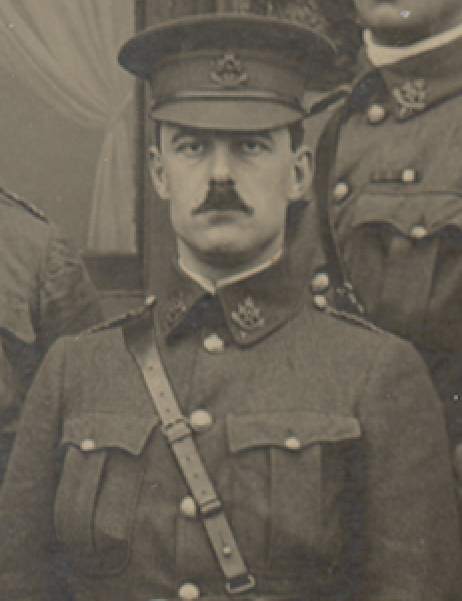
Captain Reginald Saxby taken in 1909
2/Lt Alec Harrison Goodall
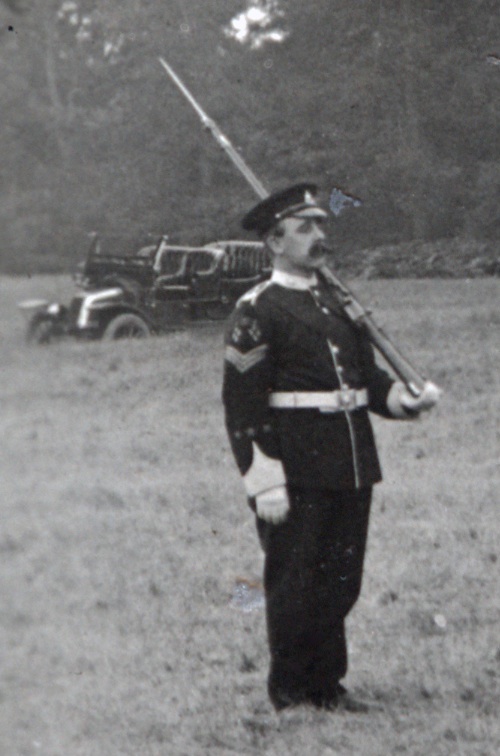
280 Company-Sergt.-Major John Platts taken in 1914

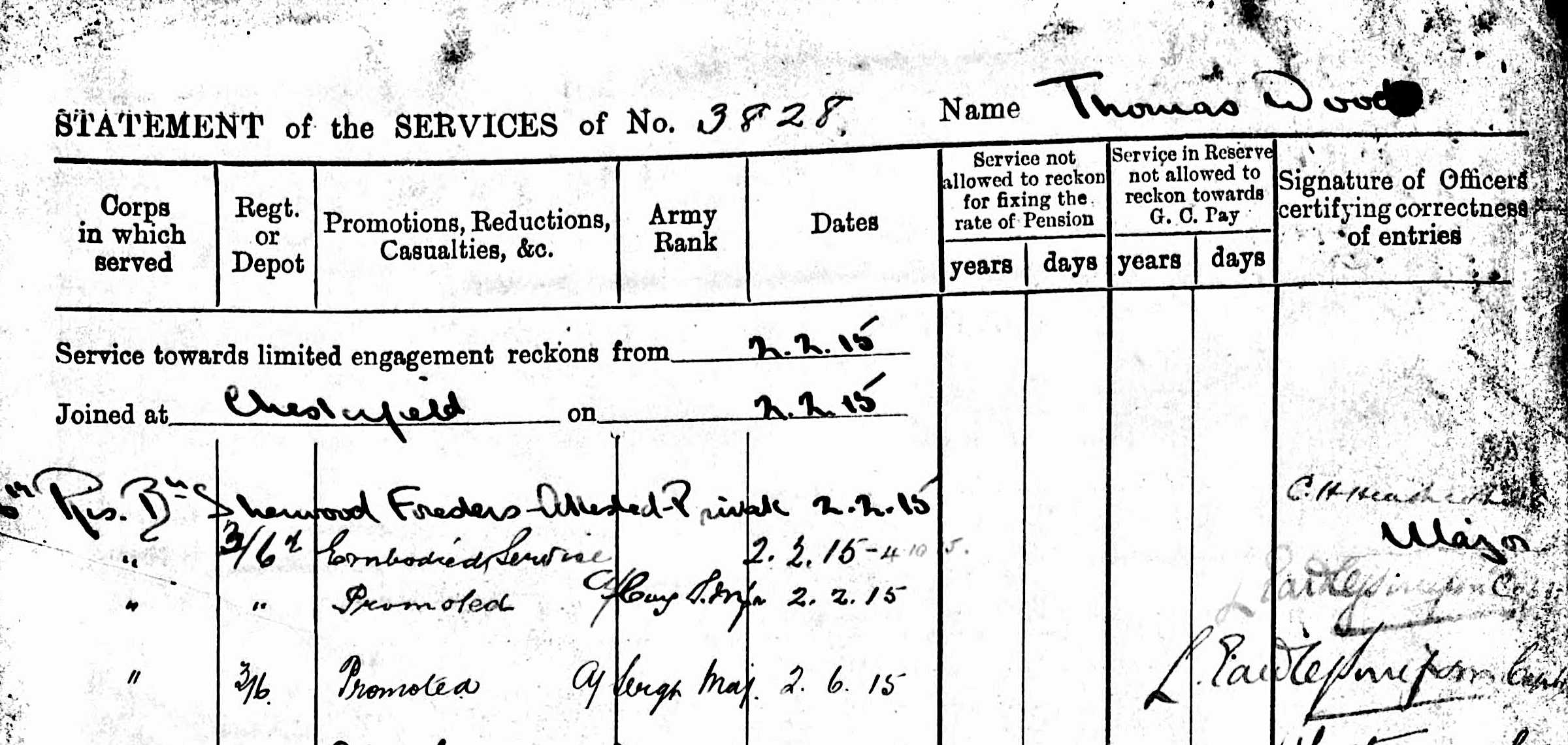
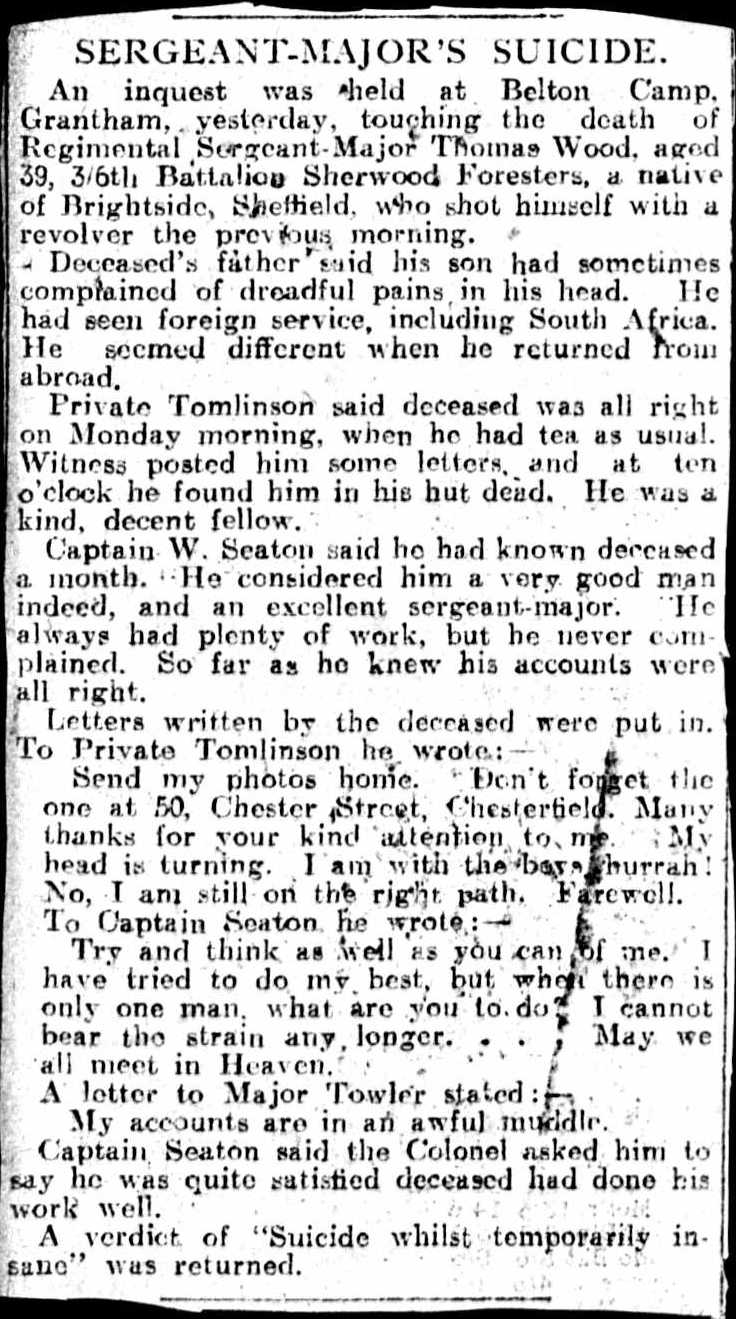
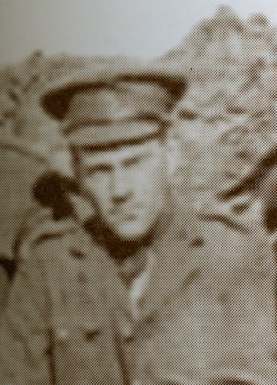
The tragic suicide of 3828 Company Sergeant Major Thomas Wood from Sheffield

On the 4th October 1915 at Belton Camp near to Grantham

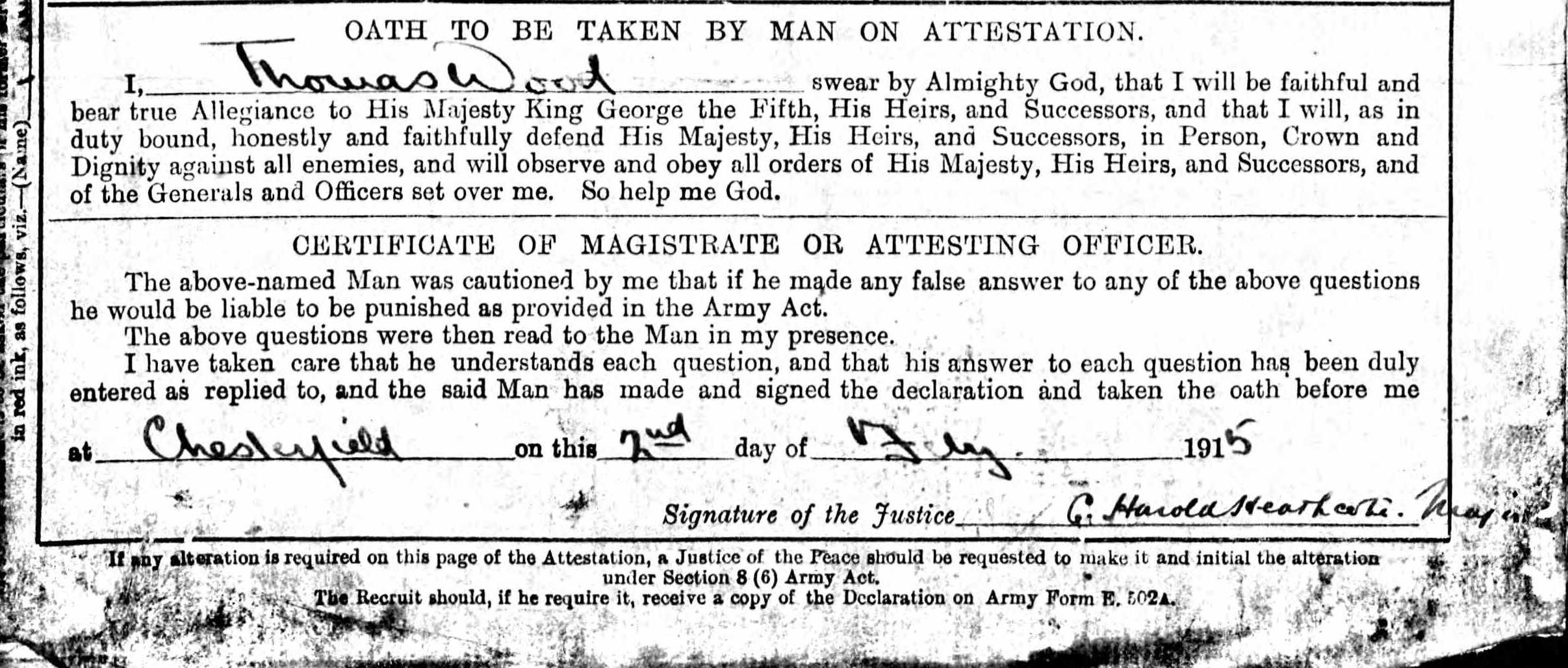
Thomas was a 38 year old clerk when he enlisted into the 6th Reserve Battalion, the Sherwood Foresters in Chesterfield on the 2nd May 1915. Thomas had previously served over 18 years with the 2nd Battalion Kings Own Yorkshire Light Infantry and rising to the rank of Colour Sergeant.
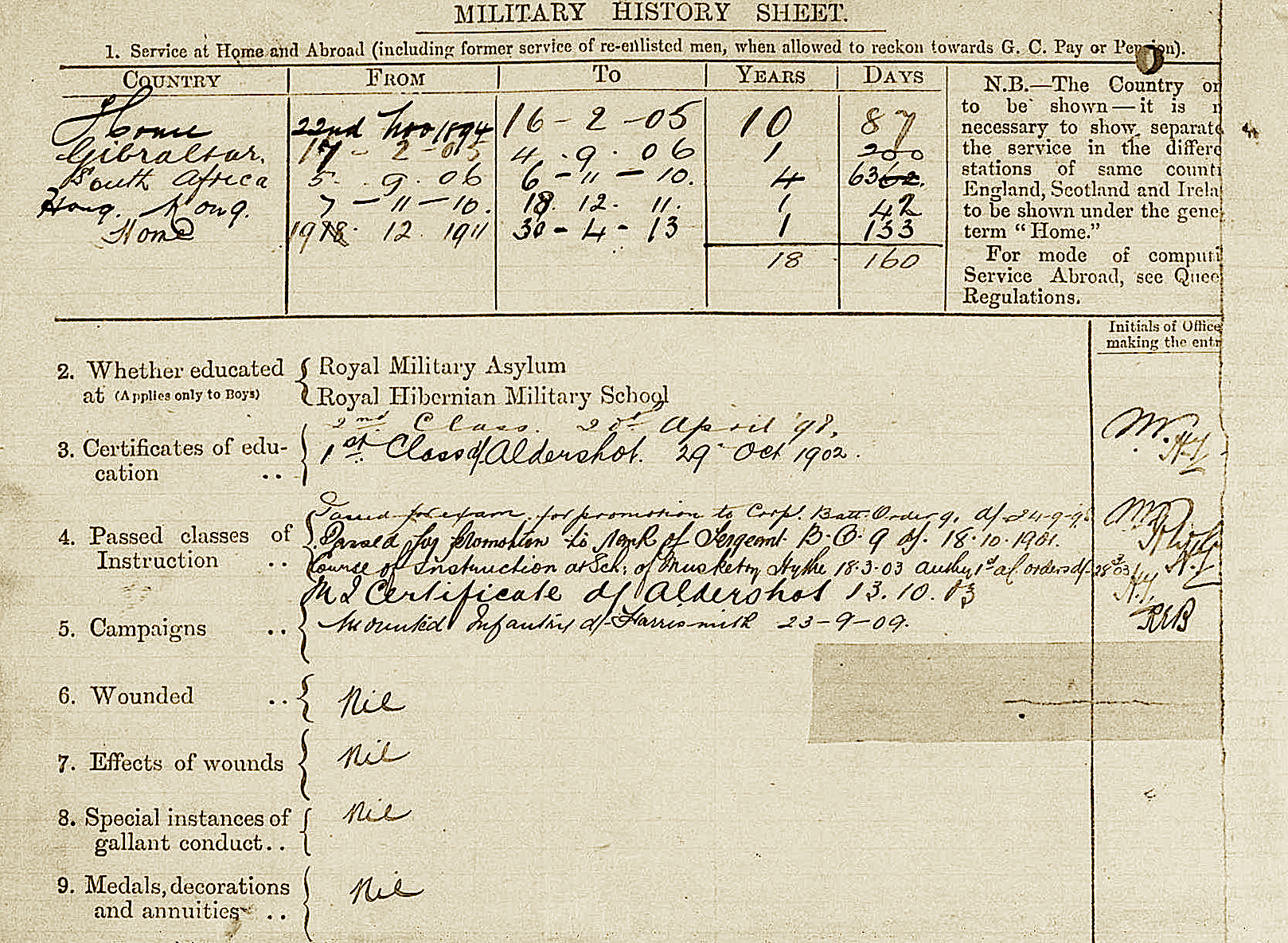
Service Record for Thomas Wood recording that he had served in South Africa and Hong Kong and has passed numerous courses of instruction.

Attestation of Thomas Wood witnessed by Major C Harold Heathcote
Thomas was immediately posted to the 3/6th Battalion and promoted to the rank of Acting Company Sergeant Major. He was subsequently promoted to Acting Sergeant Major in June 1915.
In October 1915 Thomas took his own life
Newspaper article

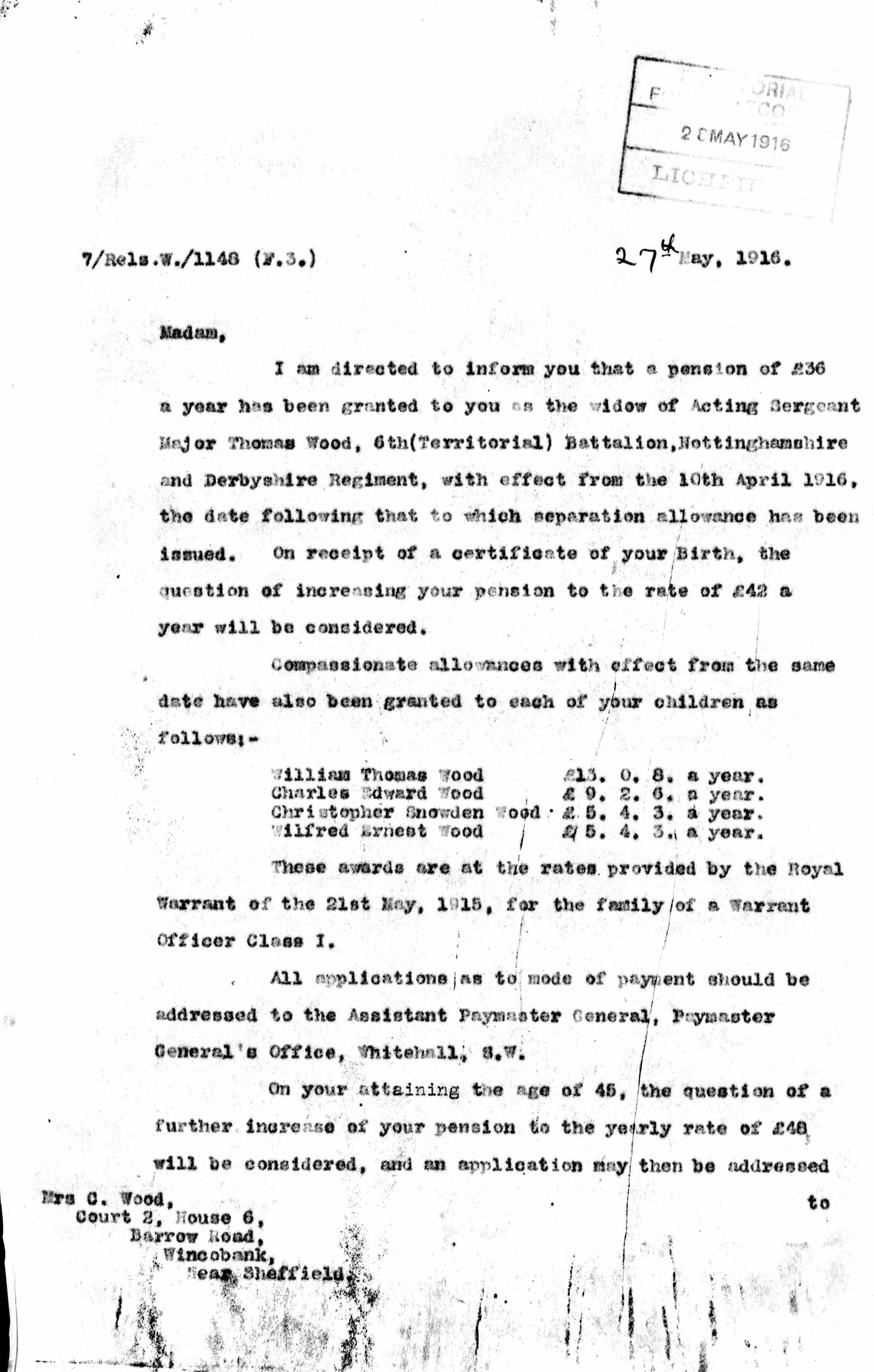
Captain William Seaton, who had known him for a month, described Thomas as a very good man indeed and an excellent sergeant-major. Thomas left a wife and four sons who received a pension.

It would appear from Captain Seaton’s testimony and Thomas’s final letter that he was under considerable pressure “Try and think as well as you can of me. I have tried to do my best, but when there is only man, what are you to do? I cannot bear the strain any longer”

Thomas wrote to Major Towler stringing that “my accounts are in an awful muddle”, but on examination “so far as he knew the accounts were alright”.

The History of the 3/7th Reserve (Robin Hood) Battalion Sherwood Foresters, written in 1921, records that there were a shortage of Officers and NCOs in these early days of the Reserve Battalions.


Thomas’s widow Catherine and their four young sons were awarded a pension.
4478/241531 Pte Francis Yates

1/6th Battalion and Labour Corps; arrived in France in 1916 and wounded on 1st July 1916
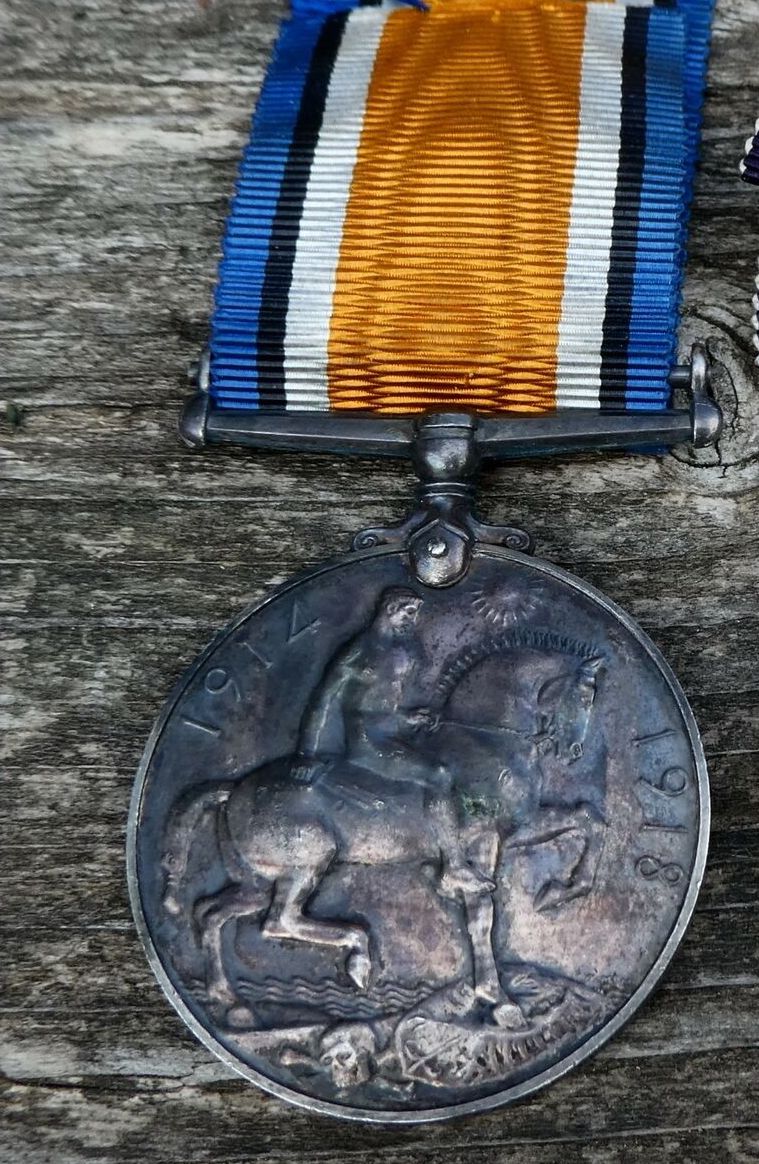
Unfortunately very little is known about Francis Yates, but it would appear that he arrived in France in 1916, served with “B” Company and was wounded on the 1st July 1916 [Information from 1/6th Battalion casualty book formerly kept in Officers Mess at Chesterfield Drill Hall].

Interestingly his medal index card does not record his 4-digit Regimental number (4478), whilst the 6-digit number (241531) would suggest that he was ‘still with’ the Sherwood Foresters in Spring 1917. His 4-digit number indicates that he enlisted in early August 1915.

Indeed, there is a reference in the Grantham Journal on Saturday October 16 1915, that Privates Philip Larkin, Frederick Watts and Francis Yates of the 3/6th Battalion where brought before Chesterfield Borough Bench for being ‘absent without leave’. At the time the 3/6th Battalion were camped at Belton Park with the rest of the 3rd North Midland Division.
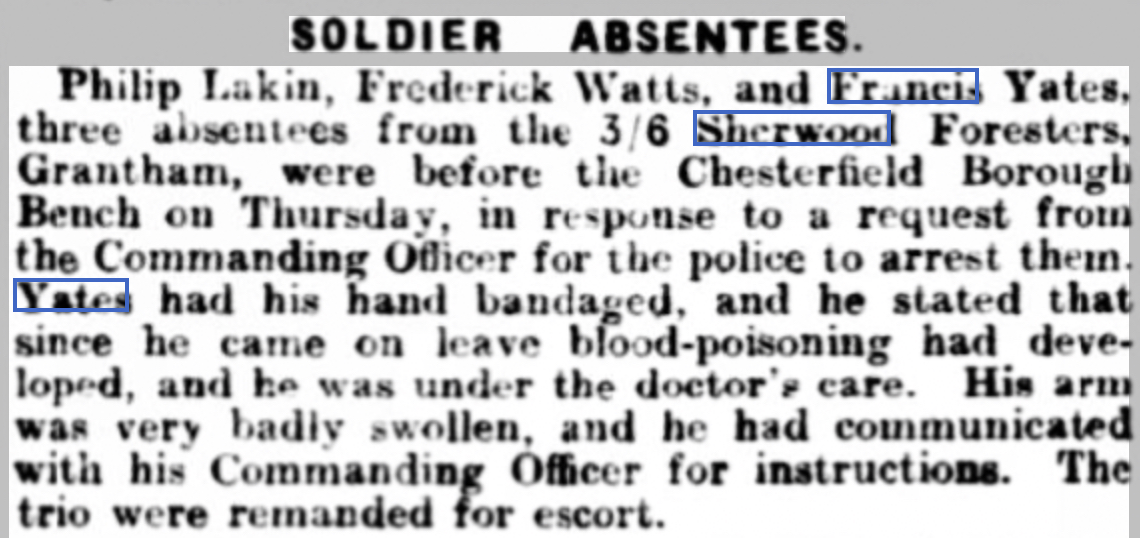
Grantham Journal
1/6th Battalion casualty book formerly kept in the Officers Mess at Chesterfield Drill Hall
Birmingham Evening Post, Friday 4th August 1916 confirming Francis Yate’s wounding. Amongst the other Sherwood Foresters is 2198 W Barnes from Stafford
Admission list for No. 2 General Hospital confirming the wounding of 2198 Pte W Barnes of the 1/5th Battalion on the 1st July 1916

At some point Francis was posted to the Labour Corps and given the regimental number 601701. From a search of the Army Service Records of 601763 Pte Eli Rushton, 601795 Pte Wilkinson Haworth and 601798 Pte Edward Rumbol (who all have similar 6017** regimental numbers) it would appear that this transfer happened in June-July 1918.

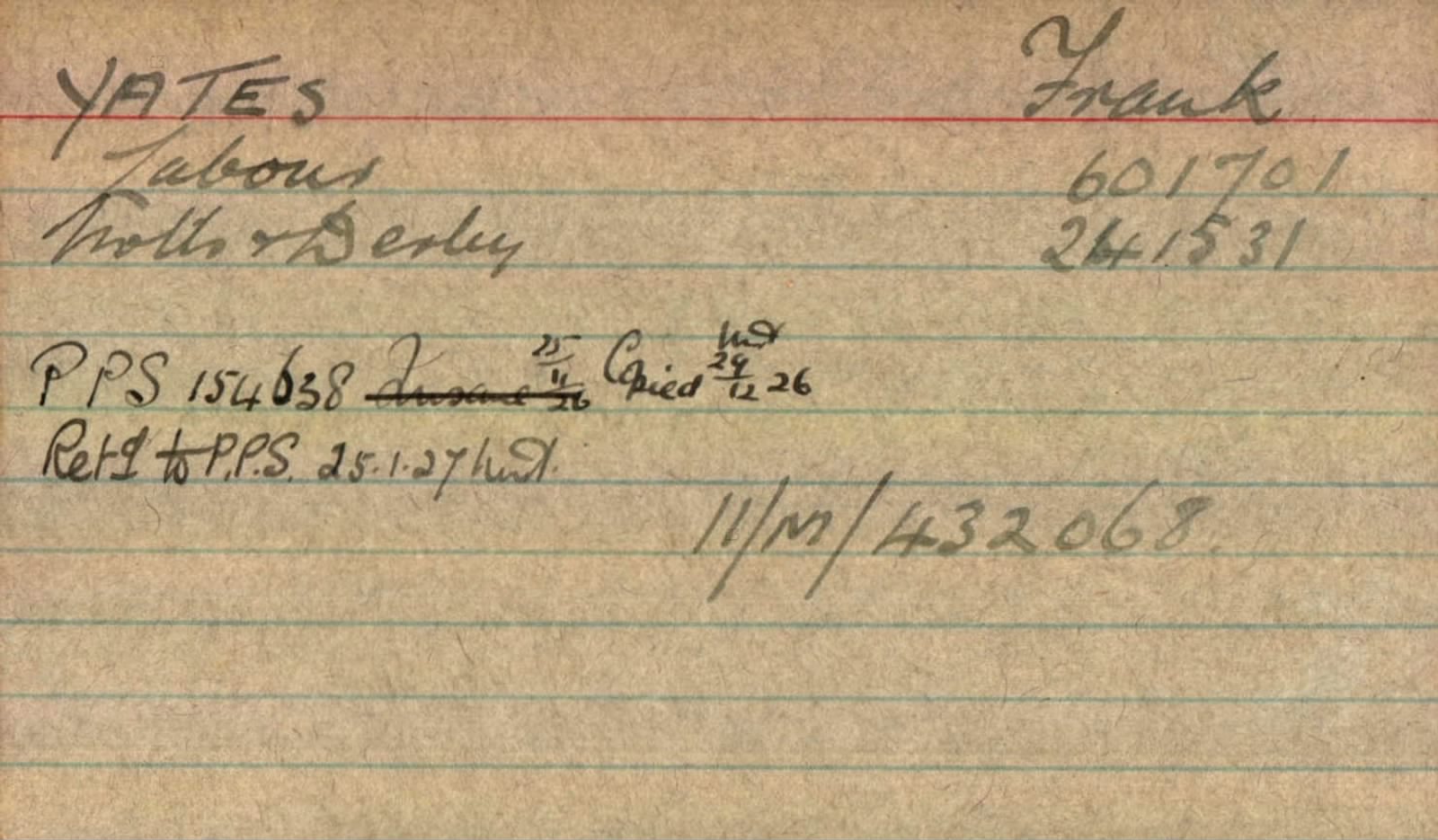
MIC only recording 241531 and 601701
Francis was awarded a Pension

Another great purchase……..

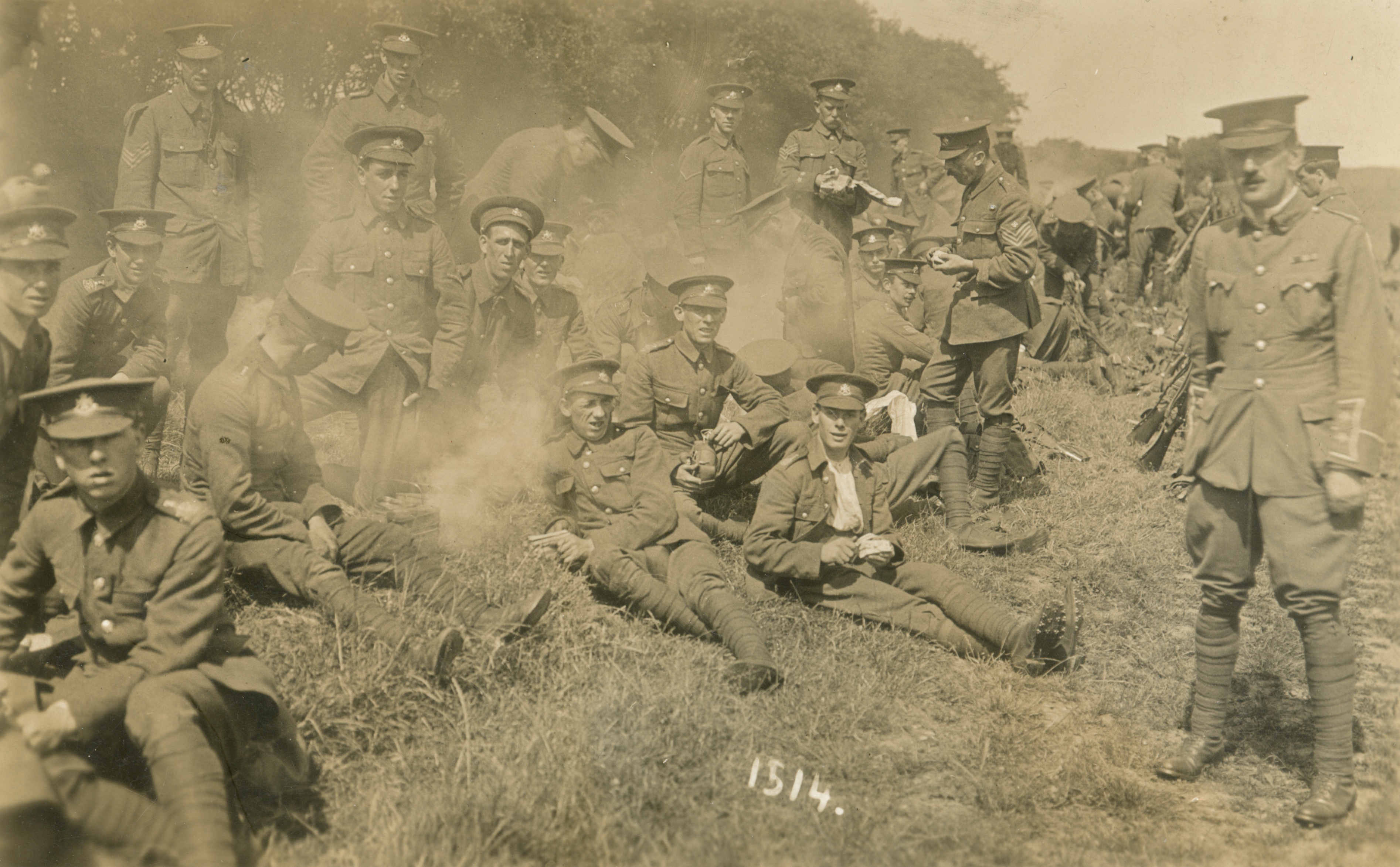
Hunmanby August 1914

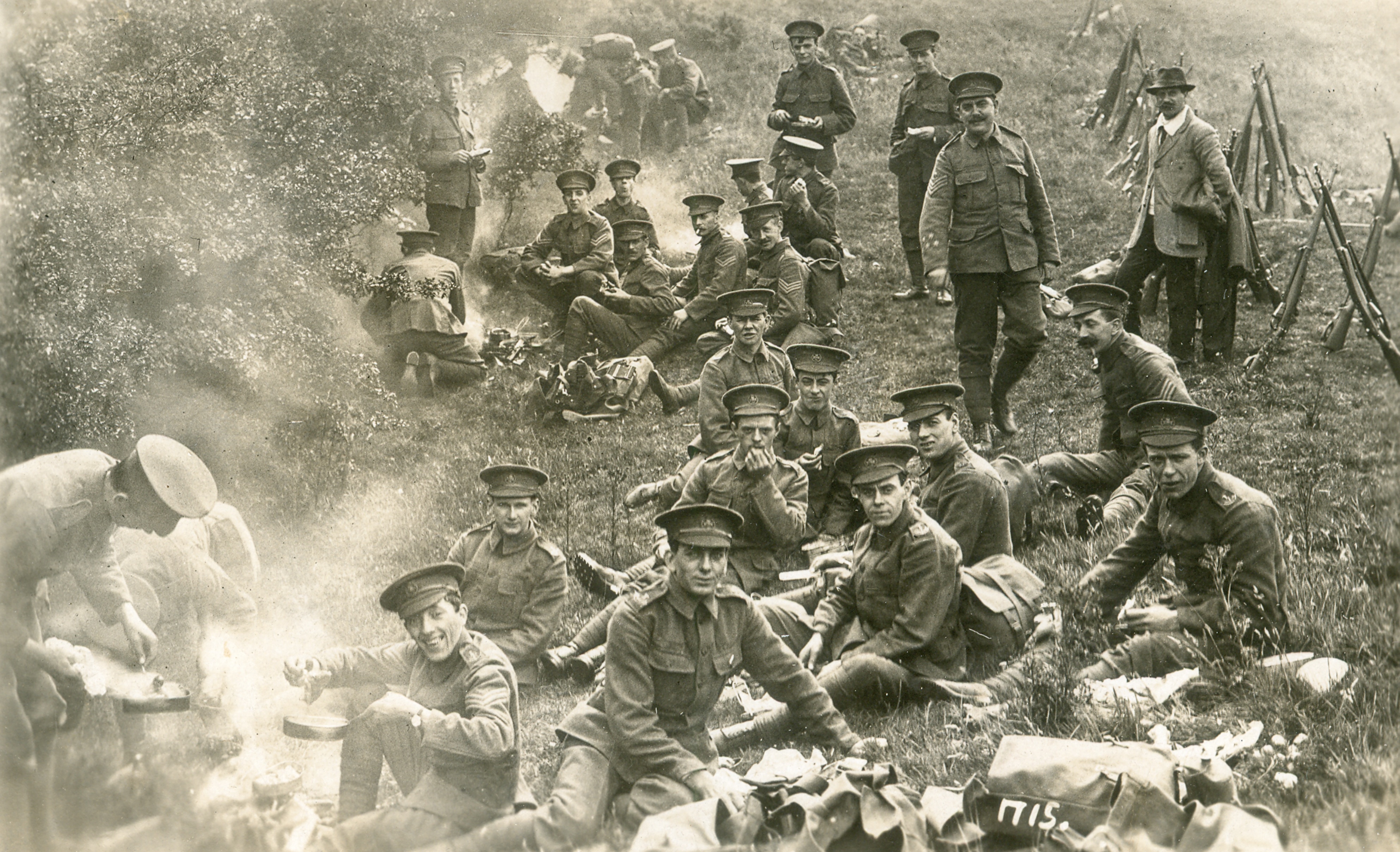
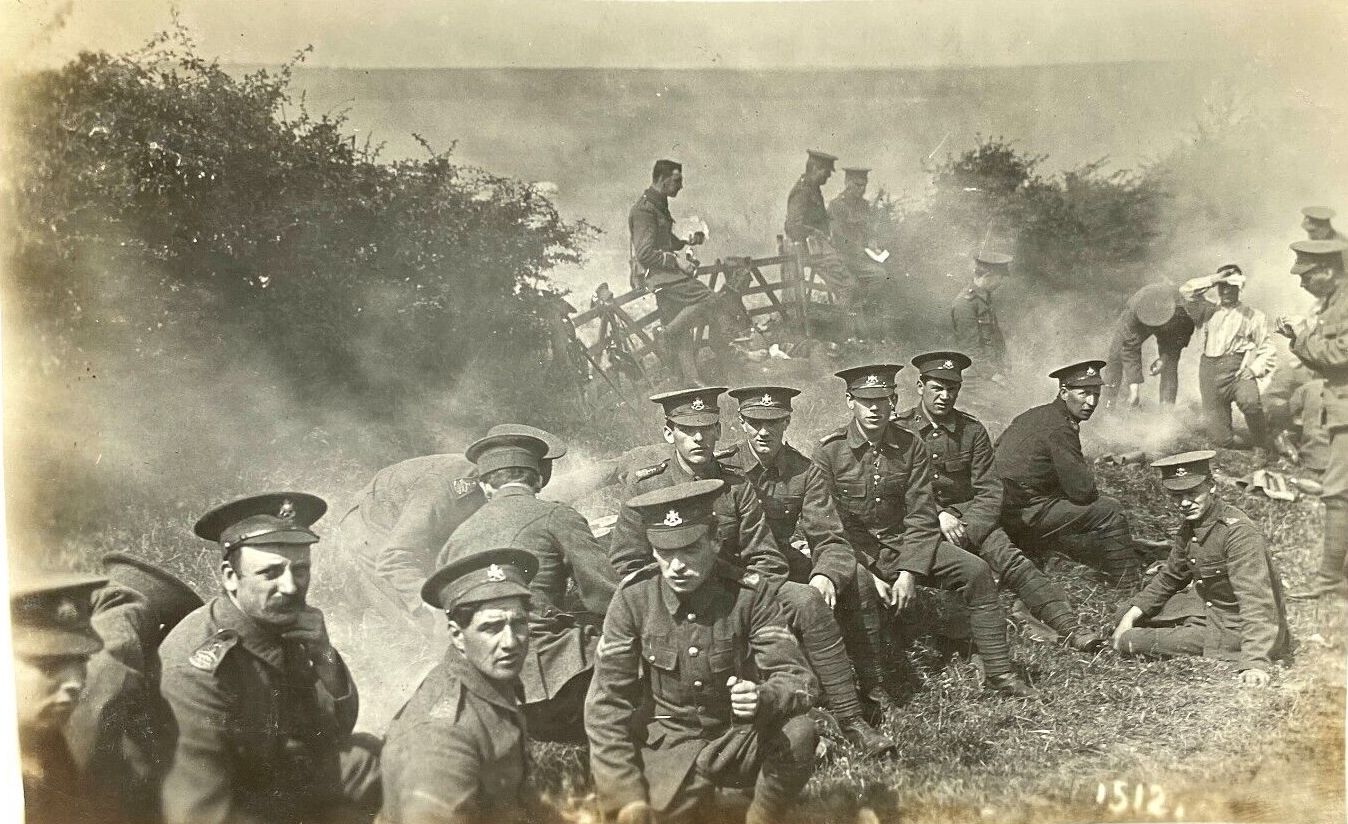
Pictures of the very short Summer Camp of 1914 in Hunmanby are hard to find and this is only my second……….

The reason being – War was declared and the men of the Sherwood Foresters quickly returned to their home station for mobilisation.

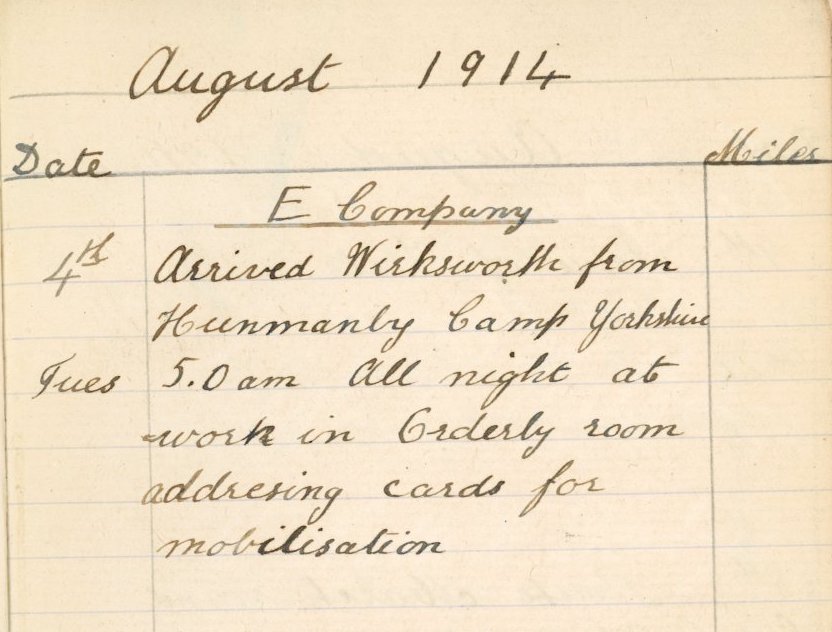
This is epitomised by the entry in Sergeant Percy Walker’s diary…

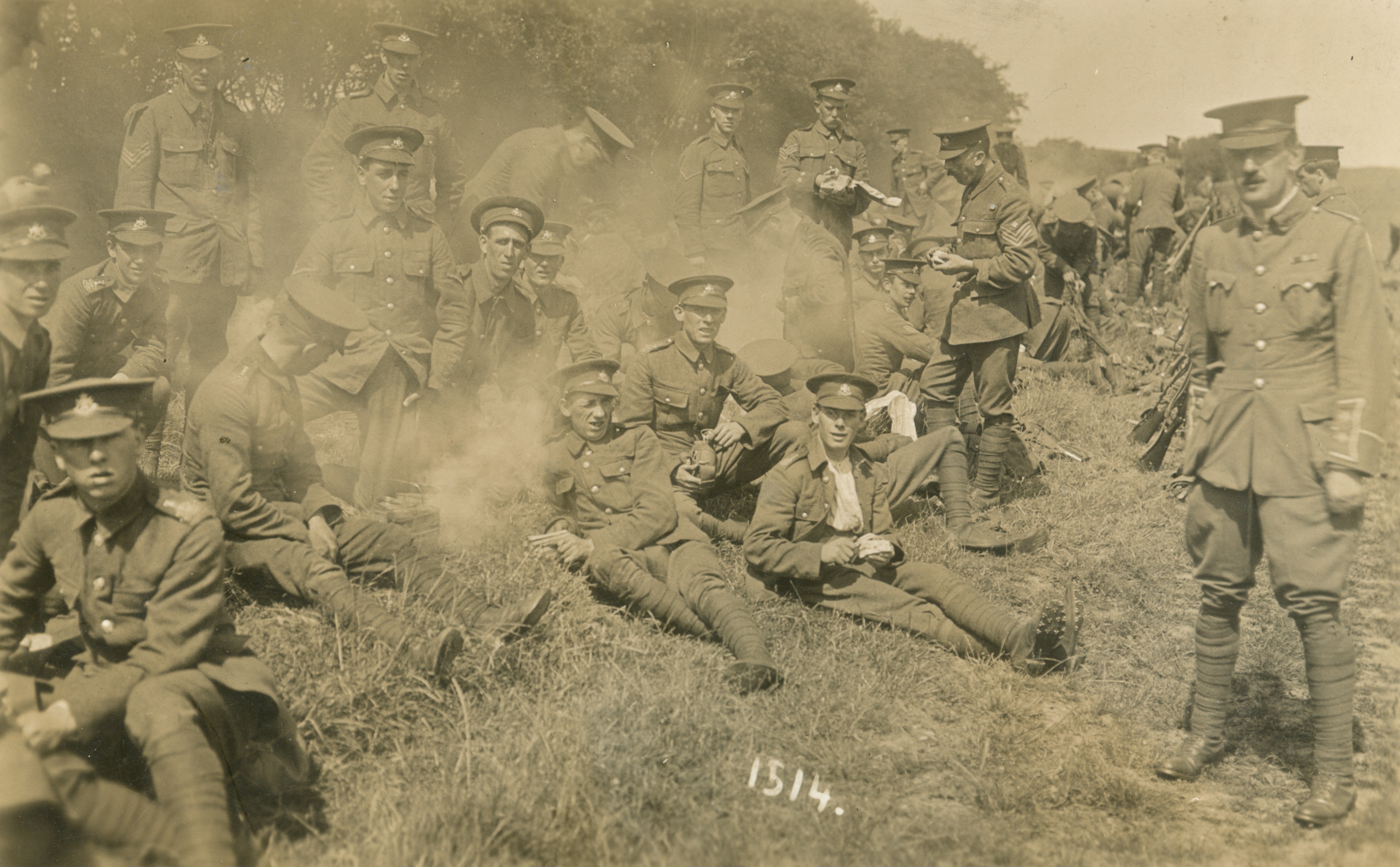
The picture shows men of the 5th or 6th Battalions cooking by the roadside…
Is this T5 or T6……
I’m calling this as T5
Great shot!

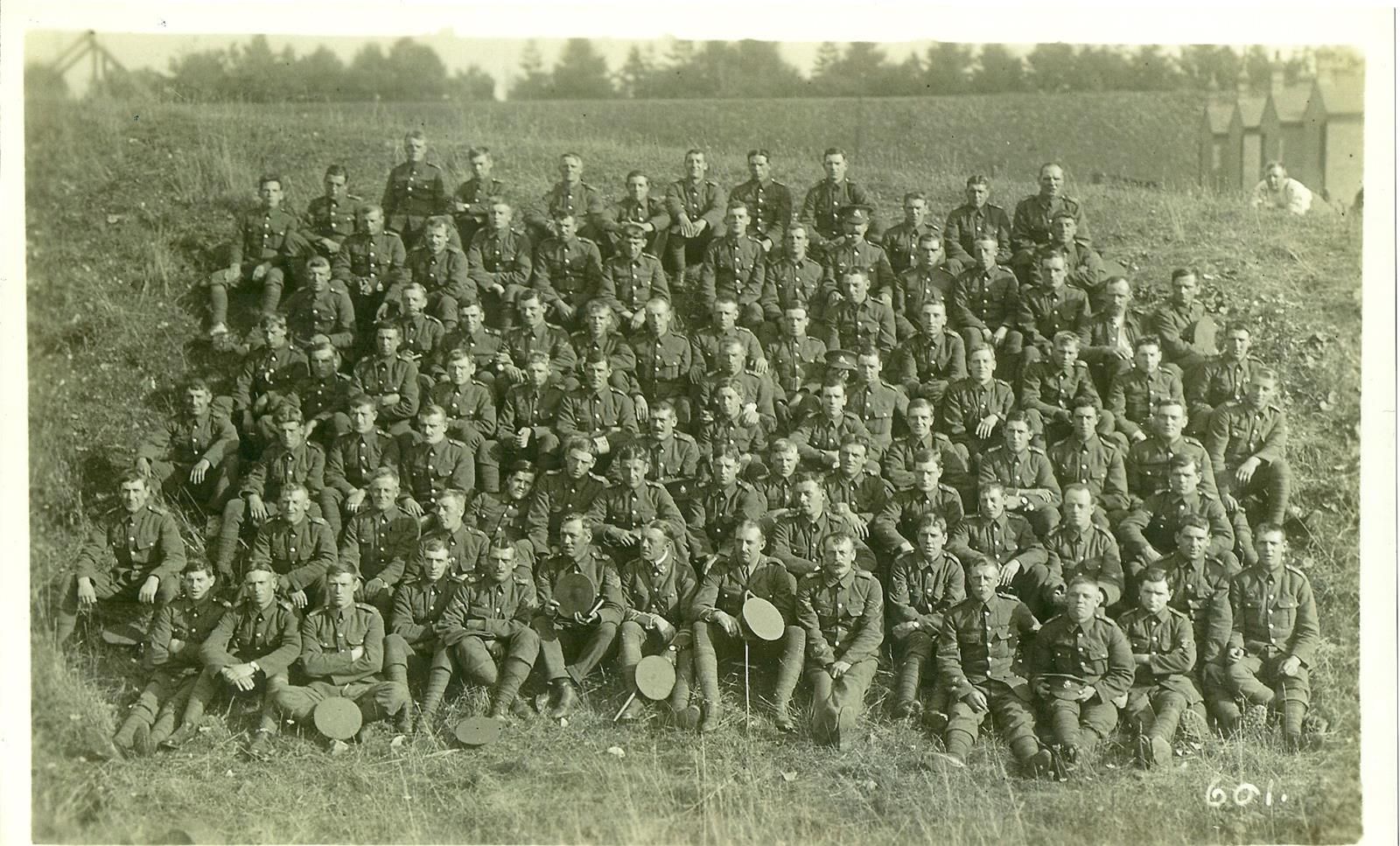
And just for comparison – here is the Robin Hood Rifles…..same photographer……just taken later

RHR at Hunmanby in August 1914

9/5673/241979 Percy Walker………an update

Many thanks to Pery’s great grandson son Granville, who has very kindly sent me copies of family photos and Percy’s diary, we can now fill in Percy’s service with the Sherwood Foresters.


Born in 1882 in Wirksworth, Percy was a painter by trade, and by 1911 was living at 10 Chapel Lane with his new bride Florence.

1911 Census

Service with ‘E’ (Wirksworth) Company, the 2nd Volunteer Battalion of the Nottinghamshire & Derbyshire Regiment: 1902-1914

Percy enlisted into the 2VB on the 9th of February 1901 aged 19, and served with them until their disbandment on the 31st March 1908, during which time he rose to the rank of Corporal.

Private Percy Walker, most likely taken shortly after he had enlisted
A newly promoted Corporal Percy Walker
A group of men of the 2VB at a summer Camp. Percy is possibly the man sitting at the back drinking
“E” (Wirksworth) Company taken at Towyn Camp 1907; authors collection
Percy’s record of service with the 2VB; in total 7 years and 52 days

Pre-War Service with ‘E’ (Wirksworth) Company, the 6th Battalion of the Nottinghamshire & Derbyshire Regiment: 1908-1914

Percy enlisted into the 6th Battalion on its formation on 1st April 1908 and was given the early regimental number of 9. He was assigned to No. 3 Section of the Left Half Company Commanded by 2/Lt Francis Edward Wintle. E Company was Commanded by Captain Joseph Albert Wheatcroft.

Nominal Role of Letter “E” Company circa 1908; authors own collection
Sergeants of Letter E Company; Percy is on the far right. This was taken at the summer camp of 1910, which was at Hindlow.
1910 Summer camp and a group of men from E Company; Percy is standing on the left. Note there are a number of senior NCOs standing at the back in ‘Tunic Order’
Percy also attended the 1912 summer camp at Abermaide in Wales
Letter E Company at Abermaide Camp; Percy is kneeling on the 2nd row, 7th from the left
An unknown group of men at the 1912 camp; note the pioneer kneeling on the right
On parade at Abermaide Camp.

War Service with ‘E’ (Wirksworth) Company, the 6th Battalion of the Nottinghamshire & Derbyshire Regiment: 1914

Some time prior to the outbreak of the Great War Percy had been promoted to Sergeant

On the outbreak of the War Percy started to keep a diary, which now throws light on those early days of the War and the training undertaken by the North Midland Division in the Harpenden and Luton areas.

The cover page of Percy’s diary and it’s clear that ‘Nov 11th 1918’ was added at a later date.
Interestingly the first diary entry, dated Tuesday 4th August, details the short and ill-fated summer camp at Hunmanby.
On the 6th August, just 2 days after the mobilisation of the British Army, men of Letter E Company marched the 19 miles to the Battalion Headquarters in Chesterfield
On the 10th August the ‘men of the high peak’ marched the 12 miles to Ripley and on the following day the 10 miles to Derby.
On the 15th August, 10 days ofter mobilisation, the 6th Battalion along with the Sherwood Foresters Brigade of the North Midland Division left Derby on their way to the Luton area.
The individual Battalions of the Sherwood Foresters Brigade mobilising in August 1914; authors own collection.

Percy’s diary records the training that they undertook, such as route marches, outpost work and Company/Battalion Drill. During this time Percy and the other men of the Division were billeted in private residences and the diary provides the names and addresses of these houses.

A group of E Company men billeted with a family in Harpenden; these are possibly plans of Percy
The same man seen in the photo above; note Imperial Service Badge
A group of 1/6th Battalion men; Percy is on the 2nd row

War Service with the 2/6th Battalion of the Nottinghamshire & Derbyshire Regiment: 1914-1916

On the 14th November 1914 Percy was transferred to the newly formed 2/6th Battalion, which was Headquartered at Empire Hotel in Buxton and under the Command of Colonel Clayton
Empire Hotel in Buxton; authors own collection
War Diary of the 2/6th Battalion; authors own collection
Senior NCO’s of the 2/6th Battalion at Buxton; Percy is on the far left of the rear row
Unknown Corporal on the steps outside the Empire Hotel
On the 3rd March the 2/6th Battalion moved to Luton and then Harpenden to take over the transport and billeting arrangements from the 1/6th Battalion, which were due to embark for France
On the 19th February Percy was made Acting Company Sergeant Major
The 2nd North Midland Division was inspected by General Ian Hamilton
General Ian Hamilton would later lead the Dardanelles expedition

Overseas Service with the 1/6th Battalion of the Nottinghamshire & Derbyshire Regiment: 1916-17

In April 1916 Percy would have served for 8 years in the Territorial Force, which meant that he was ‘time expired’. It appears from his Medal Index Card, Medal Roll and Silver War Badge Role that this was the case and he re-enlisted (or was conscripted) into the Sherwood Foresters and was posted to the 1/6th Battalion and given the new regimental number of 5672. He arrived in France on the 12th August 1916 and it appears that he was still with the 1/6th Battalion at time of the Territorial Force renumbering in spring of 1917 (new number of 241979).

At some point, and for some reason (possibly through wounding), Percy was transferred to the 15th Battalion.

Medal Index Card
Medal Roll showing that Percy served in France with the 1/6th and 15th Battalions

Overseas Service with the 15th Battalion of the Nottinghamshire & Derbyshire Regiment: 1917

In May 1917 Percy was wounded (GW) with VI(I) [gunshot wound of back and spine (simple flesh contusions and wounds)] and IX(I) [gunshot wounds of lower extremities (simple flesh contusions and wounds)]. At the time of his wounding the 15th Battalion were holding the front line and support trenches.

Undated sick and wounded list
Record of the 31 Ambulance Train for May 1917
15th Battalion War Diary for May 1917
Wounded men at Great Bentley Council School Hospital; Percy is on the right
King’s Certificate of Discharge for Percy Walker; authors collection

Percy was discharged in January 1918 aged 35 years and was awarded a Silver War Badge and a King’s Certificate of Discharge. He also received a pension.

Silver War Badge roll recording that Percy was discharged on the 17th January 1918 due to wounds
Percy
Embroidery done by Percy whilst in a convalescent home at Elland near to Halifax