
On the morning of 3rd October the 139th Brigade were ordered to capture the villages of Ramicourt and Montbrehain with support from the 137th Brigade on the right and the 2nd Australian Division on the left. Nine tanks had also been alloted to this attack and were due to advance immediately behind the first wave.
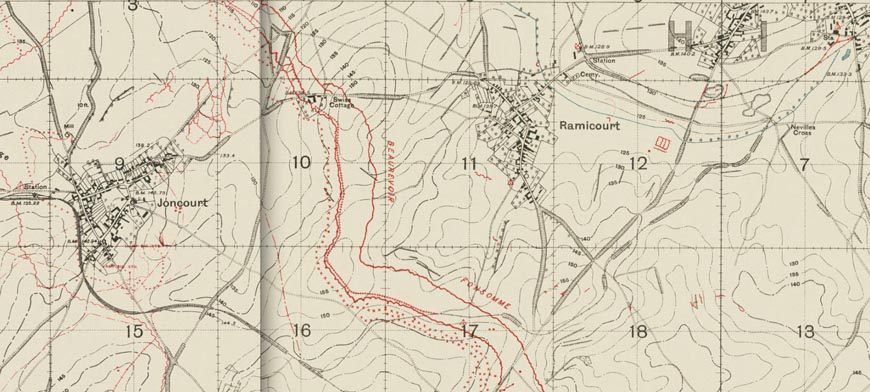
An abridged version of the attack is below, visit here for the full account.
The three battalion of the 139th Brigade moved forward and the 1/6th Battalion occupied the railway cutting as it crossed the Ramicourt to Montbrehain road approximately 200 yards from the village. The men moved cautiously towards Montebrahain using the sunken road and were ordered to pass through the village to the eastern outskirts and consolidate their positions there.
The 6th Battalion moved up the sunken road and towards the centre of Montebrahain. It was supported in this attack by the single remaining tank of the 5th Battalion Tank Corps which cleared out a nest of 16 machine guns that was holding the Battn up. Unfortunately the tank itself was put out of action shortly afterwards.
The Battalion reached as far as Montebrehain close to the blue dotted line. However, the Germans offered strong resistance around the cemetary on the north east edge of the Village. Following a series of isolated frontal attacks the village was finally rushed and cleared of Germans.
At about 12.30 pm large parties of Germans counter attacked by forming north east of the village and passing around under cover to the south east and attacking the quarries. During that attack heavy pressure was brought to bear on the 6th Battalion and they were forced to retire to a railway cutting east of Ramicourt.
Just before the Battalion were due to withdraw from Montbrehain to the reserve area, Lieutentant Percy Alexander Tompkinson, a teacher from Longton near Stoke-on-Trent, was killed. There is no record of how he died, but his body was later buried in the small cemetary that had been started next to the crucifix near the village cemetary.
Percy Tompkinson (A.23) is buried next to 2/Lt William David Baldie (A.22), a 28 year old farmer from Boolara in Western Victoria, who’s service record provides the only known description of the trench burials at Calvaire.
“….. a cross was made from Fritz Ammuniation Boxes, with his name inscribed on it and placed were he was buried.”
 Derbyshire Territorials in the Great War