Oct 9th 2am: Artillery programme continued.
Oct 9th 4am: C Coy 7th Battalion under Captain WF PLAYER attempt a raid on the enemy front line near the BLAMONT-BLAIREVILLE Road.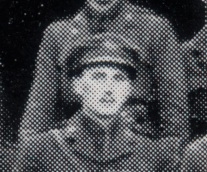
William Frederick Player from Staunton Grange in Nottingham was Gazetted to the 7th (Robin Hood) Battalion in October 1914 and arrived in France in 1915. In 1946 he became the High Sheriff of Nottinghamshire. The Family are famous for the Player brand of cigarettes made in Nottingham since 1820.
139 Infantry Brigade: Headquarters War Diary [WO95/2692]
Raid by “C” Company, the 1/7th Battalion Sherwood Foresters
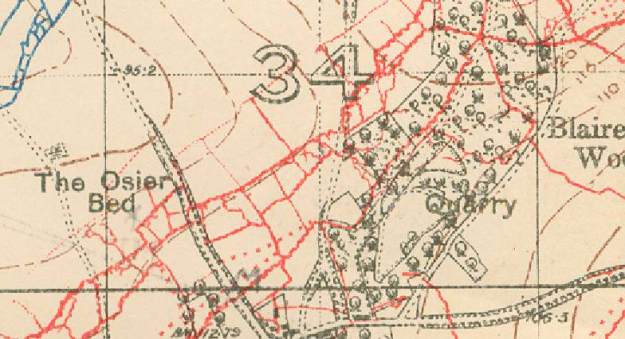
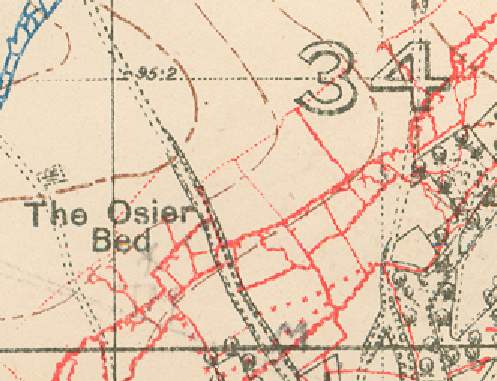
I forward a report on the raid attempted by “C” Company, 7th Battalion Sherwood Foresters last night, against the German trenches across the SUNKEN ROAD in R.34.c.
WIRE CUTTING. Four 2″ Trench Mortars had been allocated to the cutting of wire in R.34.c. Two to the feint attack in R.34.b., and one to the reopening of an old gap also as a feint in R.3.b. Firing was carried out from 12 noon to 5pm on the 7th, but owing to the collapse of 4 positions only one gasp was cut – at Sap head North of the road.
Firing was continued with 5 Mortars on the 8th for a further period of 2 hours – at the end of which the gap at the sap head had been enlarged – the wire in front of the main objective was very badly knocked about, a gap of about 20 yards was cut in R.34.b, and a good gap was cut near ITALY SAP in X.3.b. 620 rounds had been used.
On the night 8th/9th – the party detailed to enlarge a gap in our wire near BLAMONT-BLAIREVILLE ROAD at 7.15 pm found 3 German grenades and 2 caps – belonging to an enemy patrol probably detailed to look out for our raiding party.
At 8pm our 18 pounders opened a short burst of fire on the gaps in the German wire and one minute later shouts were heard in the German trenches – red lights in pairs were sent up from X.3.b. and red and green lights from both sides of the SUNKEN Road.
At 8.10 pm their artillery opened a heavy fire from a battery of 4.2 and two batteries of 77mm, and from one or more heavy trench mortars on our front and support trenches from CAVENDISH SAP R.33.d. to our left. The 41st Infantry Brigade trenches were also heavily shelled – the enemy lifting from the front to the support and reserve lines. Heavy machine gun and rifle fire had also been opened particularly from trenches north of the road.
At 2.15 pm our wire patrol got within 40 yards of the Sap head north of the road and within 30 yards of the trenches south of the road and reported that they could see no gap at the latter point.
At 3.10 pm the same patrol endeavoured to take our 1 ammonal tube but owing to the rifle fire opened by the enemy and to a hostile patrol close to the objective the attempt was given up.
At 3.20 pm the raiding party left our trenches and had advanced beyond our wire twenty minutes later. (It was found that more time ought to have been allowed for passing through our wire).
At 3.58 when a single round was fired from our artillery the party were 60 yards from their objective.
At 4 am the covering fire commenced and by 4.2 the parties had practically reached the wire before the artillery lifted. They report that very few splinters from our shells were noticed.
At 4.1 pairs of red lights were sent up from several points in the enemy’s lines (these lights and green flares being sent up constantly for some 10 or 15 minutes), particularly from X.3.b. where an attack was evidently expected). The German batteries and medium trench mortars opened an erratic fire on our front and support trenches in R.33.b. and R.34.a. while they also commenced to shell their own front line South of the SUNKEN ROAD with 77mm and light trench mortars.
At 4.2 the party North of the Road entered the Sap Head without ugh difficulty but found the Sap half filled with wire and knife rests and were unable to proceed down it. South of the Road the party were unable to find a gap or to surmount the German wire. A the pound tube of ammonal exploded in the wire proved ineffective and the knife rests were found to be too firm to be removed by hand.
During this time the party was under constant rifle and machine gun fire from a gun in an emplacement probably near R.34.c.38.29 and from another on their right flank which was engaged by our Lewis Gun.
The enemy commenced to throw grenades from his Support line and from the flanks of the objective, and after bombing their front line our party was brought back at 4.14 am, via the OSIER BED to our front line.
The casualties consisted of one man killed (brought in), 3 wounded and 2 wounded at duty.
The artillery support proved to be extremely effective. The enemy’s trenches in X.3.b. and R.34.b. have been badly damaged and the gaps in the wire at these points drew a good deal of artillery and rifle fire away from the main objective.
53 rounds were fired during the night bombardment by the Medium Trench Mortars and 700 rounds by the 139th Stokes Battery, 25,500 rounds were fired by the 139th Machine Gun Company during the operation.
Captain William Percy Buckley, DSO, 1st Battalion, Duke of Cornwall’s Light Infantry
3394 Corporal Claude Wolley
London Gazette 9.12.1916: At Derby Sap on the morning of 9th October 1916, he was in charge of a Stokes Mortar and took part in a bombardment of the enemy’s lines during a raid. He kept his gun in action for half an hour whilst his position was subjected to a heavy bombardment by the enemy. During this time he showed exceptional coolness and courage and kept his team together by his excellent example. On 30th September 1916, at 10.30pm he also showed great coolness and devotion to duty when he took a Stokes Mortar into No Mans Land and bombarded the Blockhouse, though fired at continuously by an enemy machine gun.
1466 Corporal Arthur Ford
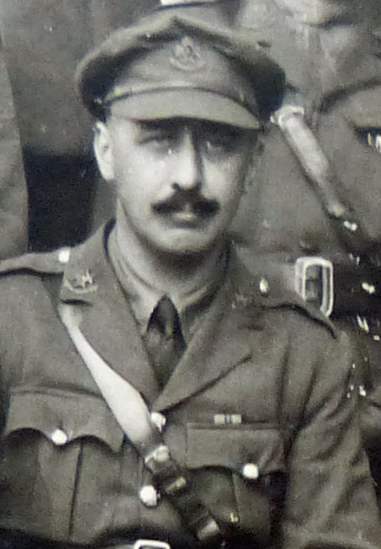 11.10.1916 BAILLEULVAL: Major E Hall rejoined Battalion from sick leave.


 Derbyshire Territorials in the Great War
