Monthly Archives: March 2014

On this day 12th March 1915

12.3.15 (Bac St. Maur): SHERWOOD FORESTERS Brigade detached to II CAVALRY DIVISION under Major Gen. Gough.

————————————

12th March 1915: We were standing by all day. At night we could see an artillery duel in the distance. Part of the mill here has been used as an ammunition stores by the Germans. The English had blown it up. I never saw iron twisted as much in my life. On this day the Notts and Derby Brigade was attached to a Cavalry Division Commanded by General Gough. Nearby was a big naval gun 15.7 ins. Shook the whole factory when fired. Aeroplanes flying in all directions.

[2381 Pte. George Potter Bagshaw]

On this day 11th March 1915

11.3.15 (Bac St. Maur): Battalion with Sherwood Foresters Brigade marched at an hour notice and billeted in factories – Remainder of N. Midland Division about SAILLY. BAND at HAZEBROUCK where they played before Sir JOHN FRENCH and the PRINCE OF WALES.

——————————————

On MARCH 11th we marched 16 miles to a place called Bac St-Maur, and there we were billeted in a mill where rope is made from hemp.  Next to the mill is a building that has been blown up by our 2nd Battalion.  It was an ammunitions store belonging to the Germans, when they were here our 2nd Battalion lost a lot of men in the canal close by.  This mill belonged to a German firm.

[1415 L/Cpl Alfred Afford]

11th March 1915. Standing by until 10-30 when we got a sudden order to move. We were going by 11-30. We marched sixteen miles through Estaires to Bac St-Maur. Here we were billeted in a weaving shed. I slept under a warping machine. At this place we were local reserves to the 1st Army Corps under General Haig a big battle going on at Neuve Chappelle.

[2381 Pte. George Potter Bagshaw]

Then marched 12 miles (Mar 11th) to Bac St Maur & stayed in a cotton or twine mill in reserve for 2 nights. (Rather cold).

[3289 Pte George William Beardsley]

On this day 10th March 1915

10th March 1915. Standing by all day waiting for orders. As you passed through Nieppe, which is just in Belgium, it was a pity to see the sorrowful looks on women’s faces.

[2381 Pte. George Potter Bagshaw]

—————————

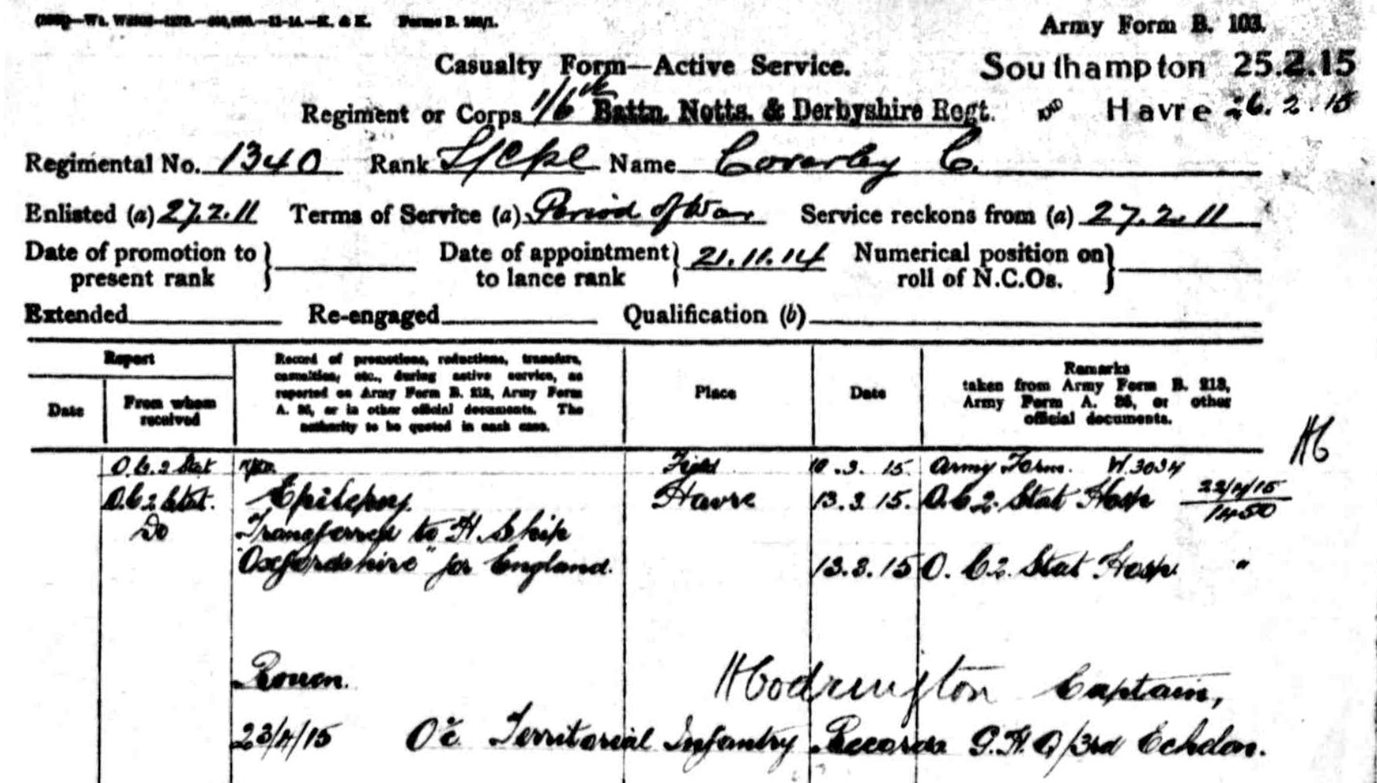
Men taken ill during on this day included:-

  • 1340 Pte. Charles Coverley, a labourer from New Mills who suffered from epilepsy and was evacuated to England. Discharged April 1915.1340 Coverley
  • 1682 Pte. Sidney Buffey a burner from Stonegravels who was admitted to the 1st NMFA and 9 Staionary Hospital. Returned to duty in June 1915.

On this day 9th March 1915

9.3.15 (Outtersteene): Battalion with S.F. Brigade marched to billets picking up band at BAILLEUL.

———————————————————————

MARCH 9th. We marched away from Nieppe to a place called Outtersteene, a distance of 14 miles. The Germans were at this place on the retreat from Mons, they were in the same billet as I am for 9 days. On coming through Nieppe we saw an aeroplane duel, one German and two English, they did not fetch him down but flew wide so that our guns could find him, they fired 11 shells at him, but he escaped. We are in France again.

[1415 L/Cpl Alfred Afford, D Company]

9th March 1915. Reveille 5-30 a.m. Left the barn at 8-00 a.m. Marched to Outresteen, a distance of about eleven miles, going through Bailleul. We got a very good billet in an empty house which was in charge of a Belgian refugee. Guarded by aeroplanes all the way.

[2381 Pte. George Potter Bagshaw]

On this day 8th March 1915

8.3.15 (Ploegsteert): L/Cpl Redfern ‘C’ Company killed on 8th with working party.

—————————————-

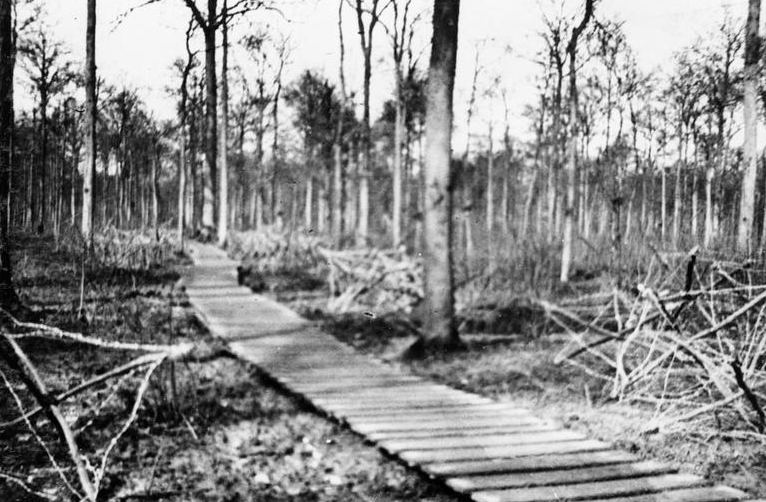
8th March 1915. Reveille 5-30 a.m. Went to wash up in a ditch nearby. The water was frozen over. We had to break the ice before we could wash (rather parky). We fell in at 7-30 a.m. to go as a fatigue party for the Engineers at Ploegsteert Wood. We were working just behind the firing line making corduroy paths.

Courdroy pathCorduroy path through Ploegsteert Wood. Imperial War Museum © IWM (Q 11744).

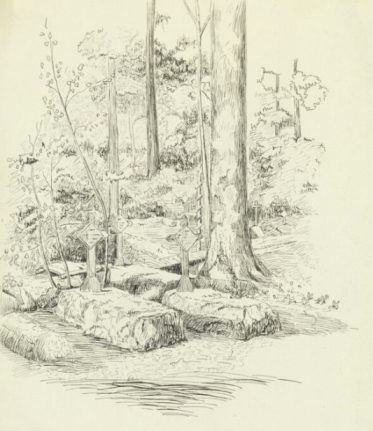
These paths have all sorts of names ‘Bunhill Row’ etc. Plans are drawn of these paths just as though it was a town. All the time we were working there, stray bullets would come and shells would go whistling through the trees. C Company were doing their turn in the trenches that day. In the middle of the morning we got the news that Lc Corporal Redfern had been shot through the heart by a sniper. They buried him half an hour later in the cemetery in the wood.

Ploegsteert graveCemetery in Plugstreet Wood, May 1915. A view of several graves marked with wooden crosses and plaques in Ploegsteert Wood. Imperial War Museum © IWM (Art.IWM ART 4786).

We went for a walk in the morning in the wood, we saw something in a ditch. We touched it with a stick and there it was a dead German. We left at 1 o’clock for our billet. In Ploegsteert Wood the Somerset Light Infantry and Rifle Brigade were stationed. When we arrived back to our barn we had orders to pack up so as to be off next morning. We received our first mail in France here.

[2381 Pte. George Potter Bagshaw]

————————————————–

RedfernL/Cpl 1470 Allen Redfern of Buxton who was the first man to be killed on active service. He is now buried in the original Plot I of Ploegsteert Wood Military Cemetery in Belgium.

Redfern 21470 L/Cpl Allen Redfern a printer from Buxton, who was serving with “C” Company, was shot through the heart whilst on duty with a working party behind the lines; he was only 20 years of age. Allen was buried in Somerset Light Infantry Ground in Ploegsteert Wood and was the only 6th Battalion man to be buried in that cemetery.

On this day 7th March 1915

On MARCH 7th at 5.30 p.m. we were under heavy shell and rifle fire.  I was put on snipers duty, at this time I was only 45 yards from the German sniper.  On our return the Germans were shelling the place we came through this place is called Ploegsteert, at this place churches and houses have been burnt down and shelled.

[1415 L/Cpl. Alfred Afford]

———————–

7th March 1915. It is a Sunday. What a Sunday one never to be forgotten. We had the order at 5-00 a.m. to stand bye. We stood for an hour and then we began to fill sand bags to strengthen the trenches. As you passed certain places a bullet would come whizzing past your head into a tree nearby. That place would be marked by a sniper and had you stopped just in that place it would have meant that you would receive that bullet.

Soon after breakfast word came ‘stretcher bearers wanted’; a man had got killed with a sniper just behind us. He had been out since August. Hard lines half an hour after being killed he was buried. All the men worked just as though they were in ordinary times.

After dinner the order came down the line ‘At 3-30 p.m. the artillery on the left will begin to bombard German trenches, be ready for attack if necessary’. Exact to the minute the artillery began. What with the noise of the artillery, maxims and rifles it was something never to be forgotten.

When filling sandbags it was a common occurence to put your shovel into a dead German. In this wood on the 19th of December there were 2,000 casualties when the English drove the Germans out of the wood.

We left the trenches about 4-30. On our way through the wood we passed the English burial ground. It is a piece of ground railed round, full of graves with wooden crosses over the graves, all the graves being well cared far. A sight once seen never forgotten. On our way back to our billet we passed many graves by the road side. In the village of Ploegsteert which is just behind the wood, there were many houses wrecked by shell fire, the Church in particular. The roads here are in an awful state, for where the shells drop it leaves a great hole and you can’t tell there is a hole there because it is full of mud. When you drop up to the knees in mud you feel inclined to swear. We got back to our billets about 6 o’clock for a meal of bully beef and biscuits.

[2381 Pte. George Potter Bagshaw]

—————————————————–

The man killed on this day was 7420 L/Cpl. Henry Miller of the 1st Battalion Somerset Light Infantry.

7420 Henry Miller

Henry was from Chard in Somerset and was a pre War Regular who was stationed at Verne Citadel in Portland Weymouth in the 1911 Census.

On this day 6th March 1915

MARCH 6th. We went for the first time up to the trenches, these are only 150 yards from the enemies trenches and we were under shell fire, we went on fatigue with the Royal Engineers repairing the firing trenches.

[1415 L/Cpl. Alfred Afford; D Company]

———————————————————————–

6th March 1915. Knocking about all day until 4 o’clock when we went into the trenches at Ploegsteert Wood. This is in Belgium. It was about three miles from where we were billeted. The wood is a wonderful place, all pathways made through by the Engineers, just like a town. In the trenches, which are made of sand bags there are dug outs which the men have their meals in and sleep in. Each dug out has a seperate name such as ‘Hotel de Rochart’, ‘Castle Dase’ etc.

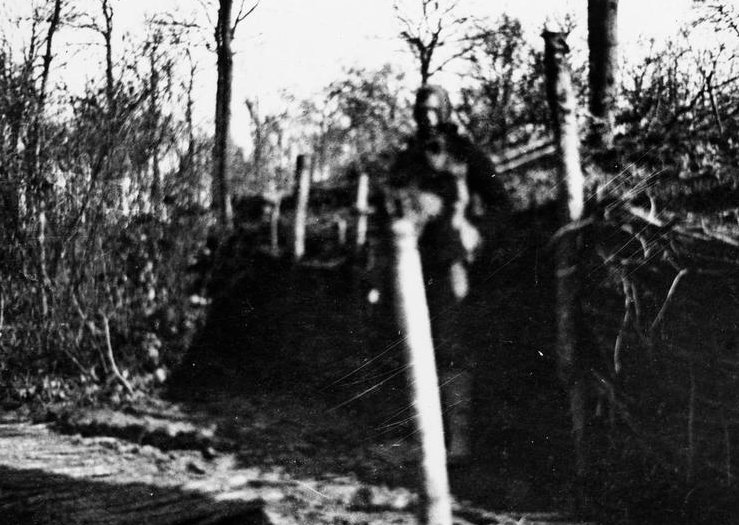
Company MessCompany Mess in Ploegsteert Wood. a view of a dug-out constructed from earth, wood, sandbags and corrugated iron. Courtesy of the Imperial War Museum © IWM [Art.IWM ART 4815].

I was put in charge of a trench where there were about seven regulars and five terriers. I felt rather nervous, but that soon went off. During the night I went with the Sergeant to the listening patrol which is about 60 yards from the German trenches. We could see the Germans working on their wire entanglements. The Germans kept sending up rockets lighting everything up everywhere, making us keep our heads down because of the snipers who are always on the lookout. As you go between the trenches you come across dead Germans, both having laid there for a week or two.

[2381 Pte. George Potter Bagshaw]

On this day 5th March 1915

5-8.3.15 (Ploesteert): The Battalion attached Headquarters A & C Companies to SOMERSET LIGHT INFANTRY and B & D Companies to 1/RIFLE BRIGADE in trenches and working parties.

BreastworksBreastworks held by the London Rifle Brigade, Ploegsteert Wood. 1914-15. Imperial War Museum © IWM (Q 11743).

—————————————————–

5th March 1915: Line piquet all day. Never seen as much mud in my life. There was a grave nearby with about 75 N.C.O.’s and men buried in it.

[2381 Pte. George Potter Bagshaw]

The graves that George Bagshaw refers to are most likely those of 42 men the 1st Battalion SOMERSET LIGHT INFANTRY CEMETERY who were killed in action on 19th December 1914. The men had died during an attack by the 11th Brigade on the "German Birdcage" east of Ploegsteert Wood, which had failed with heavy casualties, many of which had been caused by the British artillery firing short.

On this day 4th March 1915

4.3.15 (Terdeghen): Battalion marched to S. SYLVESTRE where with the 5th Battn it was inspected by the Colonel – Gen. Sir H. L. SMITH-DORRIEN. Then enbussed for BAILLEUL (where Band left). Then marched to OOSTROOVE FARM near PLOEGSTEERT and billets. There attached to 11th Brigade – Brig. Gen. HASLER.

————————————

MARCH 4th. Inspected by General Smith Dovien at Terdeghem and then rode in motors to a place called Armentieres 3 miles from the firing line, this is in Belgium. And here we were billeted in an old roofless barn.

[1415 L/Cpl. Alfred Afford]

4th March 1915. We were inspected by Smith Dorrien. Reveille at 6-00 a.m. Left Terdeghen at 8-00 a.m. Marched two miles, went by motor bus to Bailleul and then marched seven miles to a farm near Dieppe. Never had such a march in my life, what with cobble stones and mud -awful. The mud was up to the knees in same places. When we got there we were all tired out and to crown it all B Company was made line piquet for 24 hours. That is have your equipment on all the time and be ready for anything. At night the artillery was firing and one shell dropped about 100 yards from our barn. Ready for home any time. Here we got one slice of bread besides the biscuits.

[2381 Pte. George Potter Bagshaw]

On this day 3rd March 1915

March 19153.3.15 (Terdeghem): Telegraph to Division from H. M. The King.

Telegram March 1915WO/95/2694

—————————————-

Stretcher drill. Rained very hard all day. Toothache very bad all week. Getting rather anxious as to what is happening at home. Wrote letters every day and found out that none of them had gone.

[2381 Pte. George Potter Bagshaw]